Singles vs Ice Dance: A 2-Time Olympic Coach's Honest Guide for Parents
QUICK NAVIGATION
📖 In this guide
A 2-time Olympic coach walks you through every decision point — from costs to timelines to what actually fits your child.
Your child just finished Basic 8. They love the ice. They're hungry for more. And now the skating director pulls you aside and says a sentence that will quietly shape the next ten years of your family's life: "It's time to choose a discipline."
Singles or Ice Dance.
Most parents nod, smile, and go home to Google frantically. I know, because I've had this conversation with hundreds of families at Krigor Studio. And what I've learned after two Olympic Games and twenty years of coaching is that the information out there is either too technical, too vague, or too biased toward whichever discipline the writer happened to compete in.
So let me do something different. Let me tell you what I'd tell my closest friend's kid, without the marketing gloss.
The one-sentence difference that actually matters
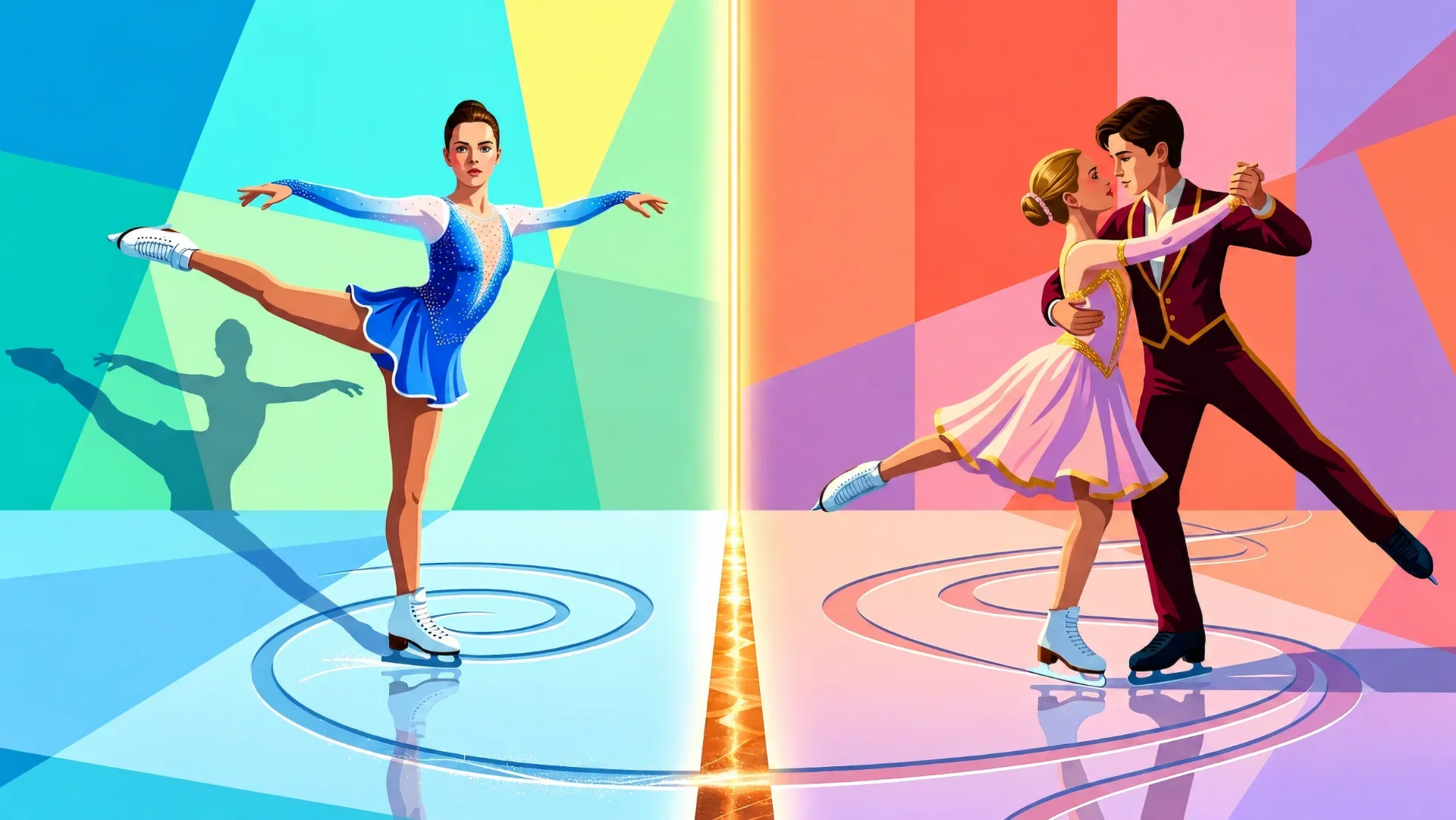
Singles is about flight. Ice Dance is about connection.
A single skater's career is measured in rotations in the air. An ice dancer's career is measured in the depth of edges underneath their feet and the synchrony of their movement with music, a partner, and the ice itself. Both require elite athleticism. Both take a decade to master. But they demand fundamentally different nervous systems.
Everything else — the costs, the competitions, the schedules, the injury patterns — flows from that one difference.
What Single Skating actually is
Single Skating is what most people picture when they think "figure skating." One skater, one program, and the jumps that win or lose competitions: the Axel, the Lutz, the Flip, the Loop, the Salchow, the Toe Loop. At the elite level, we're talking triples by age 12 and quads by age 16 for the most competitive skaters.
The International Skating Union judges a single skater on a technical score (jumps, spins, step sequences) and a performance score (skating skills, transitions, choreography, interpretation). But let me be honest with you: in Single Skating, jumps drive placement. A skater who lands a clean triple flip will beat a skater with beautiful artistry and only doubles, almost every time. That's not an opinion — that's the scoring system.
Who thrives here: Explosive children. Kids with fast-twitch muscle fiber. Children who don't fear falling, who bounce up after a slam on the ice and immediately ask to try again. Children who get bored with slow repetition and come alive when there's a new trick to learn.
What parents need to know: The injury profile is serious. A competitive single skater will take thousands of falls onto their hip, their back, and their wrists by the time they're 16. Hip impingement, stress fractures in the lower back, and chronic ankle issues are common. This is not to scare you — it's to tell you what's real. Great coaching mitigates this significantly. Poor coaching accelerates it.
What Ice Dance actually is
Ice Dance is figure skating's answer to ballroom. There are no jumps (technically, none above a half-rotation). No throws. No overhead lifts at the senior level. What there is — and what takes a lifetime to master — is edge quality, musicality, timing, and the kind of unison with a partner that makes two people look like one.
An ice dancer is judged on rhythm patterns, choreographic sequences, and how fully their skating interprets the music. At the top levels, an ice dance duo skating a rumba doesn't look like they're performing a rumba — they are the rumba.
There are two branches, and this is where families often get confused:
Solo Ice Dance is a rapidly growing discipline recognized by U.S. Figure Skating and increasingly by the ISU. Your child skates alone, performs pattern dances and free dance programs, and competes individually. It's a perfect path for technical perfectionists who love the dance aesthetic but aren't ready to commit to partner work.
Couples Ice Dance is the classical Olympic discipline — the one you watch every four years. This path opens up to U.S. Championships, the Grand Prix series, Four Continents, Worlds, and ultimately the Olympics.
Who thrives here: Children with a natural ear for music. Kids who notice when the tempo shifts. Children who love the details — the angle of a free leg, the exact timing of a turn, the way the edge curves under them. Often, but not always, children who studied ballet or rhythmic gymnastics first.
What parents need to know: The injury profile is much lower than Singles. But the emotional complexity is higher, especially in Couples Ice Dance. You are not just raising an athlete — you are raising one half of a partnership. Tryouts, partner changes, and the interpersonal work of skating with another human being are part of the career.
How to actually tell which one fits your child
Forget what they say they want. Seven-year-olds want to be whatever they saw on TV last week. Here's what to actually watch:
Watch them in the Learn to Skate group class. Are they the first to try the new skill, even if they fall? They're probably built for Singles. Are they the one who watches, studies, and then executes the skill more cleanly than anyone else on the third try? They're probably built for Ice Dance.
Watch them outside the rink. Do they move to music when a song comes on in the car, without being asked? Ice Dance. Do they climb everything, jump off furniture, and treat gravity like a suggestion? Singles.
Watch their attention span. Singles rewards children who can grind the same jump entry 40 times in a session. Ice Dance rewards children who can hold focus on microscopic technique — the exact quarter-turn of a hip over the blade — for the same duration.
Neither is better. Both produce world-class athletes. But the mismatch between a child's natural wiring and the discipline they're pushed into is the single biggest reason families burn out of figure skating by age 14.
The cost conversation no one wants to have
Let's talk money honestly. This is a sport that costs real American dollars per year at any competitive level, and you deserve to know what you're signing up for.
Single Skating gets expensive fast because jumps demand ice time. A lot of it. A competitive pre-juvenile single skater is typically on the ice 5–6 days a week, often with multiple freestyle sessions per day. Add private coaching, off-ice training, ballet, choreography, costumes, and competition travel, and the annual cost of a competitive singles program in the New York/New Jersey metro is substantial — and grows each year as the child ascends levels.
Ice Dance has its own cost curve. Pattern dances require less ice time per session than jump training, but partner ice — when you're coordinating schedules with another skater, often from a different family — is its own logistical investment. Couples Ice Dance adds travel costs for partner tryouts, and the coaching fees are typically shared between two families, which softens the hit.
Solo Ice Dance is, in my honest opinion, the best value in the sport right now for a technically-minded child. You get USFS and ISU competition opportunities without the partnership logistics or the jump-related injury costs.
Whatever direction you choose, ask your coach for a written annual budget before you commit. Any coach who won't give you one is not the coach you want.
The timeline: when decisions get made
Here's the rough map, though every skater moves at their own pace:
Ages 4–6: Learn to Skate. No specialization. Just ice time, balance, fun.
Ages 6–8: End of Learn to Skate curriculum, beginning of Basic Skills transition. This is when the discipline conversation starts.
Ages 8–10: Specialization takes hold. Singles skaters are working on single-rotation jumps and beginning doubles. Ice dancers are learning their first pattern dances.
Ages 10–13: The competitive ladder begins in earnest. Regional qualifying competitions, sectionals for the strongest kids, first USFS tests at higher levels.
Ages 13–16: National pathway for the elite. For most skaters, this is also when a clear-eyed family conversation about "competitive track vs. lifelong sport" happens. Both are wonderful outcomes.
Here's what I want you to hear: a child who starts specialization at 7 and a child who starts at 10 can both reach the same elite levels. What matters far more than the start date is the quality of coaching in those critical early specialization years.
What I tell my own students' families
When a parent asks me point-blank, "Igor, what should my kid do?" — I answer with three questions.
First: Does your child light up when they land a jump, or when they finish a beautiful sequence of edges? The answer is usually obvious if you've been watching.
Second: What's your family actually able to support — the Singles schedule, the Couples Ice Dance logistics, or the more flexible Solo Ice Dance path? Be honest. A dream discipline that wrecks your family's sustainability isn't a dream, it's a slow-motion disaster.
Third: Who is your child's coach going to be? This matters more than the discipline itself. A great singles coach will take your ice-dancer-at-heart and produce a mediocre singles skater. A great ice dance coach will take the same child and produce an artist. Discipline matters. Coach matters more.
The honest bottom line
Most of the best skaters I've ever coached didn't make the choice themselves. Their parents, working with a good coach, read their child honestly and guided them to the right discipline. And then — and this is the part no article on the internet tells you — they stayed open to changing course if the first choice turned out wrong.
A child who starts in Singles and transitions to Ice Dance at 11 isn't a failure. Neither is the reverse. The only failure in this sport is pouring years of family time and resources into a mismatched path because you were afraid to revisit the decision.
Both disciplines will give your child extraordinary gifts: discipline, grace under pressure, physical literacy, friendships that span continents, and the kind of resilience that only shows up when you've fallen on your hip a few thousand times and gotten back up. Whichever path you choose, choose it with clear eyes.
And if you want help making that choice — with no agenda, just an honest assessment — reach out to us at Krigor Studio. We've been through both paths ourselves, at the highest level of the sport. We'll give you a straight answer.
Frequently asked questions
-
Single Skating gets expensive fast because jumps demand a lot of ice time. Ice Dance has its own cost curve — pattern dances require less ice time per session, but partner ice adds its own logistical investment, though coaching fees for Couples Ice Dance are typically shared between two families.
-
Solo Ice Dance is, in the author's honest opinion, the best value in the sport right now for a technically-minded child — you get USFS and ISU competition opportunities without the partnership logistics or the jump-related injury costs.
-
Ages 6-8 mark the end of the Learn to Skate curriculum and the beginning of the Basic Skills transition, which is when the discipline conversation starts. Ages 8-10 is when specialization takes hold.
-
No. A child who starts specialization at 7 and a child who starts at 10 can both reach the same elite levels. What matters far more than the start date is the quality of coaching in those critical early specialization years.
-
Does your child light up when they land a jump, or when they finish a beautiful sequence of edges? What's your family actually able to support? And who is your child's coach going to be — since a great coach matters more than the discipline itself.
Kristen Fraser & Igor Lukanin is a 2-time Olympic competitor and co-founder of Krigor Studio in Montclair, NJ, where he coaches figure skaters from first steps through international competition. Krigor Studio offers Single Skating, Solo Ice Dance, and Couples Ice Dance programs for skaters of all ages, plus online training and an annual summer camp.
Related reading: