Figure Skating Cost Breakdown: What NJ Parents Actually Pay Per Year
QUICK NAVIGATION
📖 In this guide
What does figure skating really cost in New Jersey? Honest annual breakdowns for every level — from Learn-to-Skate to elite — plus an interactive calculator.
When a family books a consultation with us, the question almost always comes within the first ten minutes — sometimes phrased apologetically, sometimes anxiously, occasionally bluntly. What's this actually going to cost us?
I respect the question. I wish more coaches in this sport answered it directly instead of dancing around it with phrases like "it depends on so many factors" and "every family is different." Both are true. Neither helps a family plan.
So here's what I'll do that most coaching websites won't. I'll walk you through the real numbers, broken down by competitive level, based on twenty years of coaching skaters in the New Jersey and New York metro area. Then I'll give you an interactive calculator so you can plug in your own situation and see what your specific path looks like.
Because the worst outcome in this sport isn't paying a lot. The worst outcome is paying a lot for the wrong things.
Why honesty about cost matters
Figure skating in the U.S. has a financial culture problem. Coaches are reluctant to quote prices. Rinks bury freestyle session rates three pages deep on their websites. Equipment retailers don't tell you that the boots you're about to buy will need replacement in 14 months.
The result is that families enter this sport with vague expectations and exit it eighteen months later with sticker shock — often blaming the sport instead of the lack of upfront information. That's not the sport's fault. It's the industry's fault for not being transparent.
The skating families who thrive — the ones whose kids are still on the ice at 16, still loving it — are the ones who knew the financial reality from year one and budgeted accordingly. The ones who burn out are usually the ones who got blindsided by costs they didn't anticipate.
So let me anticipate them for you.
The seven cost categories every skating family pays
Every figure skating budget — at every level — breaks into the same seven categories. Understanding what they are and what drives them is half the battle.
1. Private coaching. The largest line item for any competitive skater. Private lessons in the NJ/NY metro typically run $70-$220 per hour depending on the coach's level and the skater's level. Beginning skaters need 1-3 lessons per week; competitive skaters at higher levels need 4-6 lessons per week or more. Coaching costs scale with both lesson frequency and the coach's seniority — a Pre-Preliminary student working with a developmental coach is paying very different rates than a junior-level skater training with a former Olympic competitor.
2. Ice time. The non-coaching ice time that fills out a skater's training week. Freestyle sessions — the structured practice ice where skaters work without instruction — run $22-$38 per hour at most NJ rinks. A skater training 6 hours per week is on the ice for about 240 hours per year. That's not a small line item.
3. Off-ice training. Ballet, conditioning, stretching, Pilates, sometimes acrobatics. At lower levels, off-ice is optional. At higher levels, it's non-negotiable — every elite skater I've worked with does multiple hours of off-ice per week. Costs range from $30-$100 per session depending on the discipline and the instructor.
4. Equipment and apparel. Skates are the obvious cost — entry-level boots and blades run $600-$1,400, mid-range $1,500-$3,500, custom professional tier $3,500-$8,000+ — but the hidden equipment costs add up faster than parents expect. Sharpening every 30-45 hours of skating ($20-$30 per visit). Practice apparel that wears out. Replacement skates every 12-24 months for growing children.
5. Competitions. Even local non-qualifying events have entry fees ($75-$200 per event), required club membership, music editing fees, and basic costume costs. Once a skater enters the regional and national qualifying path, travel and lodging dwarf the entry fees. A family attending sectionals usually spends $1,000-$2,000 per event when you account for everything.
6. Choreography. Programs need choreographing, and good choreographers charge $500-$3,000 per program. A competitive skater needs 1-2 new programs per year. Elite skaters often pay for collaboration with internationally recognized choreographers, where fees can run $5,000+ per program.
7. Administrative costs. USFS membership ($35-$250+ per year depending on level), test fees ($25-$100 per test), required insurance, club dues. These feel small individually but add $200-$1,200 per year depending on activity level.
Realistic annual budgets by level
These numbers are mid-range estimates for the NJ/NY metro area in 2026. The interactive calculator at the end of this post will give you a personalized number for your situation.
Learn-to-Skate (Basic 1-8): $2,000-$5,000 per year. Group classes, occasional private lessons, rental skates or entry-level equipment, no competition costs. The most affordable phase of skating, by design. This is when families are deciding whether the kid is genuinely interested before investing more.
Pre-Preliminary / Preliminary: $8,000-$18,000 per year. Specialization begins. Private coaching ramps up to 1-3 lessons per week. Ice time grows to 4-8 hours per week. First competitions enter the picture. Equipment moves from rental to purchased. This is where many families experience their first sticker shock — costs roughly triple from Learn-to-Skate.
Pre-Juvenile / Juvenile: $15,000-$28,000 per year. Regional qualifying competitions begin. Coaching frequency increases. Off-ice training becomes routine. Choreography for two programs annually. Custom-fit boots and replacement blades. This is the level where serious competitive families commit and others rethink the path.
Intermediate / Novice: $22,000-$40,000 per year. Sectional qualifying competitions. Travel becomes a significant line item. Multiple coaches involved (technical, choreographer, off-ice specialist). Daily training schedules. Equipment turnover increases. Competitive Intermediate and Novice skaters are training as athletes in every sense.
Junior / Senior elite: $35,000-$70,000+ per year. National qualifying path. Significant travel including international competitions for some. Top-tier coaching rates. Specialized off-ice teams (jump coach, edge coach, choreographer, conditioning, sports psychology, sometimes nutrition). This is where figure skating becomes a major financial commitment for any family.
Adult recreational: $3,000-$10,000 per year. Adult skaters typically have flexibility that controls costs — off-peak ice times, group adult classes, ability to manage their own pace. Competitive adult skaters spend more, but most adults skating recreationally find it manageable as a hobby budget.
Adult competitive: $8,000-$22,000 per year. Adult skaters pursuing test progression and competition follow a similar cost curve to youth competitive skaters, with some savings on coaching frequency (most adults can't train daily) and equipment longevity (adult boots last 3-5 years vs. 1-2 for growing kids).
The hidden costs no one warns you about
These are the costs that don't show up in basic discussions but always show up in actual budgets.
The boot replacement cycle for growing kids. Children's feet grow. Skates that fit perfectly in October are too small by April. A growing skater can go through 2-3 pairs of boots per year. Each pair is $600-$1,500 once you factor in fitting, blades, mounting, and break-in. Some families plan for this. Most don't, and it shows up as an unexpected $2,000-$3,000 mid-year.
Ice time price escalation at peak hours. "Prime time" ice (after school, evenings, weekends) costs noticeably more than off-peak. Families that can only train at peak times — often the case for working parents with kids in school — pay a premium of 30-50% per hour over what flexible families pay.
Test session travel. USFS test sessions aren't always at your home rink. A family driving 90 minutes to a Saturday morning test session for one 4-minute test is a real time and gas cost. Multiply by 6-10 tests per year as the skater advances.
Coach travel for competitions. When your coach travels with you to a competition, you may be expected to cover or contribute to their travel. This isn't always communicated upfront. Always ask before the season starts.
Music editing. Competitive programs require professionally cut music to specific time limits. Expect $50-$200 per program for music editing.
The "switch coach" cost. When a family changes coaches — which happens often, sometimes necessarily — there's typically 3-6 months of slowed progress and overlapping costs as the new relationship is built. Plan for this if you're considering a change.
Costume creation and maintenance. Competition dresses range from $200 (basic) to $3,000+ (custom-designed with crystals). Many families have one dress per season. Some have one per program. Repairs, alterations as the child grows, dry cleaning between competitions — it adds up.
How to control costs without sabotaging development
Spending more doesn't always equal better skating. Some of the most cost-conscious families I've worked with have produced extraordinary skaters. Here's what they do differently.
Group lessons and semi-private coaching. A skilled coach running a 3-skater group lesson costs each family less than a private lesson, and at lower levels the technical content is functionally equivalent. Semi-privates work especially well for siblings or close-level peers.
Used equipment for growing skaters. Skating community Facebook groups have active marketplaces for used boots. A skater who outgrew their boots after 8 months has a pair of skates with significant remaining life that another family can buy for half the original price. There's no shame in used equipment — almost every elite skater I know used hand-me-downs at some point.
Selective competition scheduling. Not every skater needs to compete every weekend. Strategic scheduling — fewer events, more focused preparation — often produces better results than the "compete-everywhere" approach, and saves significant money.
Coach honesty about lesson frequency. The right coach will tell you when your child has reached the point of diminishing returns on lesson frequency. The wrong coach will keep selling lessons. Find the first kind.
How to use the calculator below
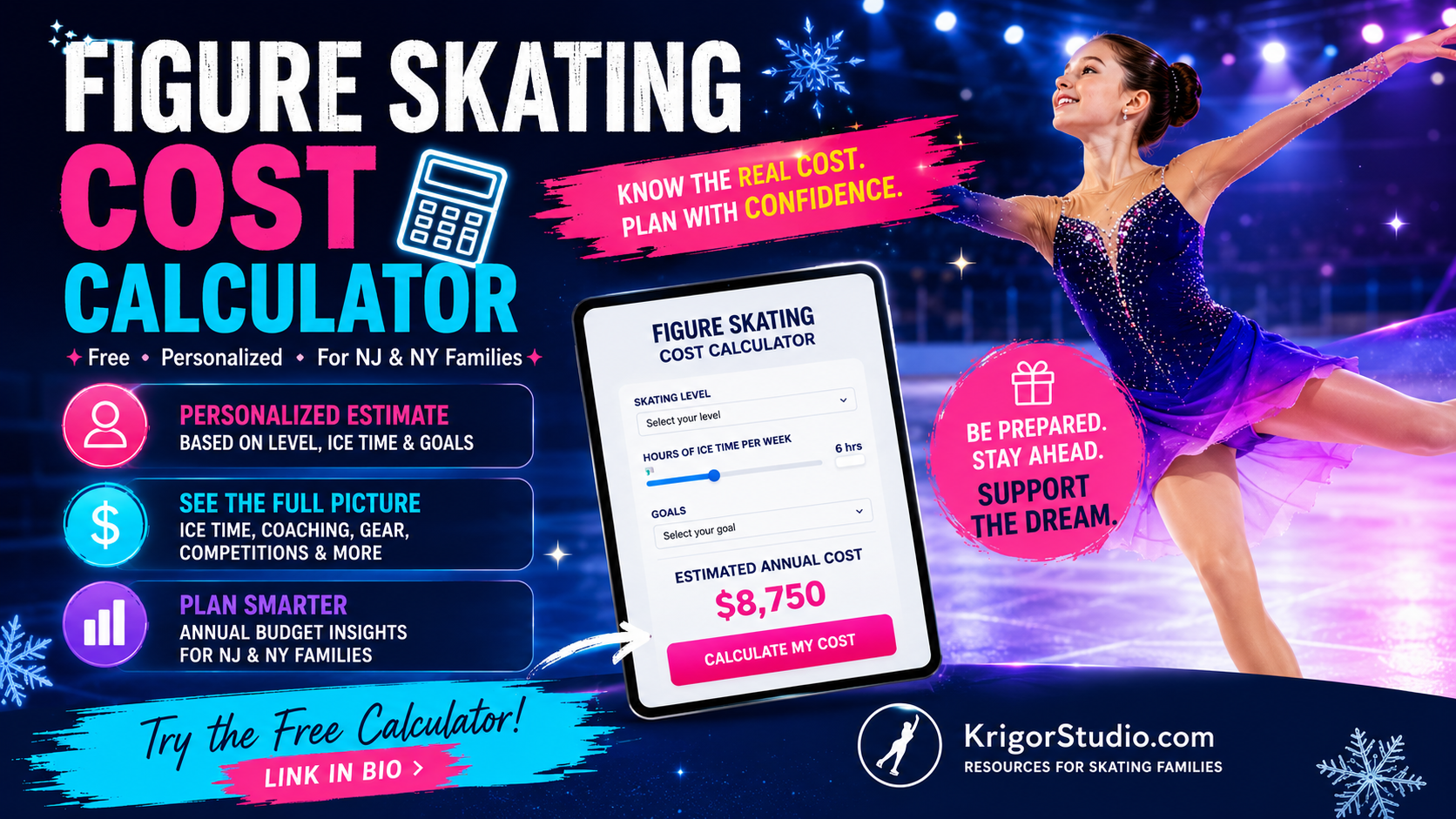
The calculator on this page lets you plug in your specific situation — level, weekly ice time, discipline, off-ice activity, competition schedule, equipment tier — and see a personalized annual estimate with breakdown by category.
Use it as a planning tool, not a precise quote. Real costs vary based on your specific coach, rink, and personal choices. But the ranges should give you a realistic ballpark for budgeting and family conversations.
A few things to keep in mind:
The estimates assume 40 weeks of active training per year (with breaks for holidays, illness, and recovery).
Coaching rates assume NJ/NY metro pricing. Other regions can be 20-40% lower.
Competition costs include realistic travel and lodging at typical levels.
Equipment costs are annualized — if you buy $2,400 in boots that last two years, the calculator counts that as $1,200/year.
Frequently asked questions
-
Every figure skating budget breaks into the same seven categories: private coaching, ice time, off-ice training, equipment and apparel, competitions, choreography, and administrative costs.
-
Learn-to-Skate (Basic 1-8) costs $2,000-$5,000 per year, covering group classes, occasional private lessons, rental skates or entry-level equipment, and no competition costs. This is the most affordable phase of skating, by design.
-
The boot replacement cycle for growing kids is the biggest hidden cost. A growing skater can go through 2-3 pairs of boots per year, and each pair is $600-$1,500 once you factor in fitting, blades, mounting, and break-in — often showing up as an unexpected $2,000-$3,000 mid-year.
-
Group lessons and semi-private coaching, used equipment for growing skaters, selective competition scheduling, and coach honesty about lesson frequency are the main ways cost-conscious families keep spending sustainable without sacrificing progress.
-
Private lessons in the NJ/NY metro typically run $70-$220 per hour depending on the coach's level and the skater's level. Beginning skaters need 1-3 lessons per week; competitive skaters at higher levels need 4-6 lessons per week or more.
A final thought
The honest answer to "What does figure skating cost?" is: more than you probably think, and worth it if your child loves it.
Every family I've worked with whose child genuinely loved skating found a way to make the budget work. They cut costs in places they could, prioritized what mattered, and built sustainable plans that didn't break the family. Every family I've worked with whose child was lukewarm about skating eventually couldn't justify the cost — and that was the right outcome.
The cost of figure skating isn't a barrier to a passionate child's success. It's a filter that makes everyone — parents, coaches, skaters — clear about whether the commitment matches the love of the sport. That clarity is worth having from year one.
If you're at the start of this journey and want to talk through what a realistic plan would look like for your family — without any pressure to enroll with us — we offer free 30-minute consultations. We've helped hundreds of NJ families build sustainable figure skating budgets, including many families whose kids ended up training at other rinks and other coaches. Honest conversation about cost is the foundation of every good skating family's planning.
Kristen Fraser & Igor Lukanin is a 2-time Olympian and co-founder of Krigor Studio in Montclair, NJ. He has coached skaters at every cost tier — from rental-skate Learn-to-Skate beginners to internationally competitive senior-level athletes — and helps families build realistic financial plans for their skating journey.
Related reading: