Adult Figure Skating: A Real Guide to Starting(or Returning) After 25
QUICK NAVIGATION
📖 In this guide
A real, honest guide to starting figure skating as an adult — what the first year looks like, how the Adult test track works, what it costs, and whether there's a competitive path for you.
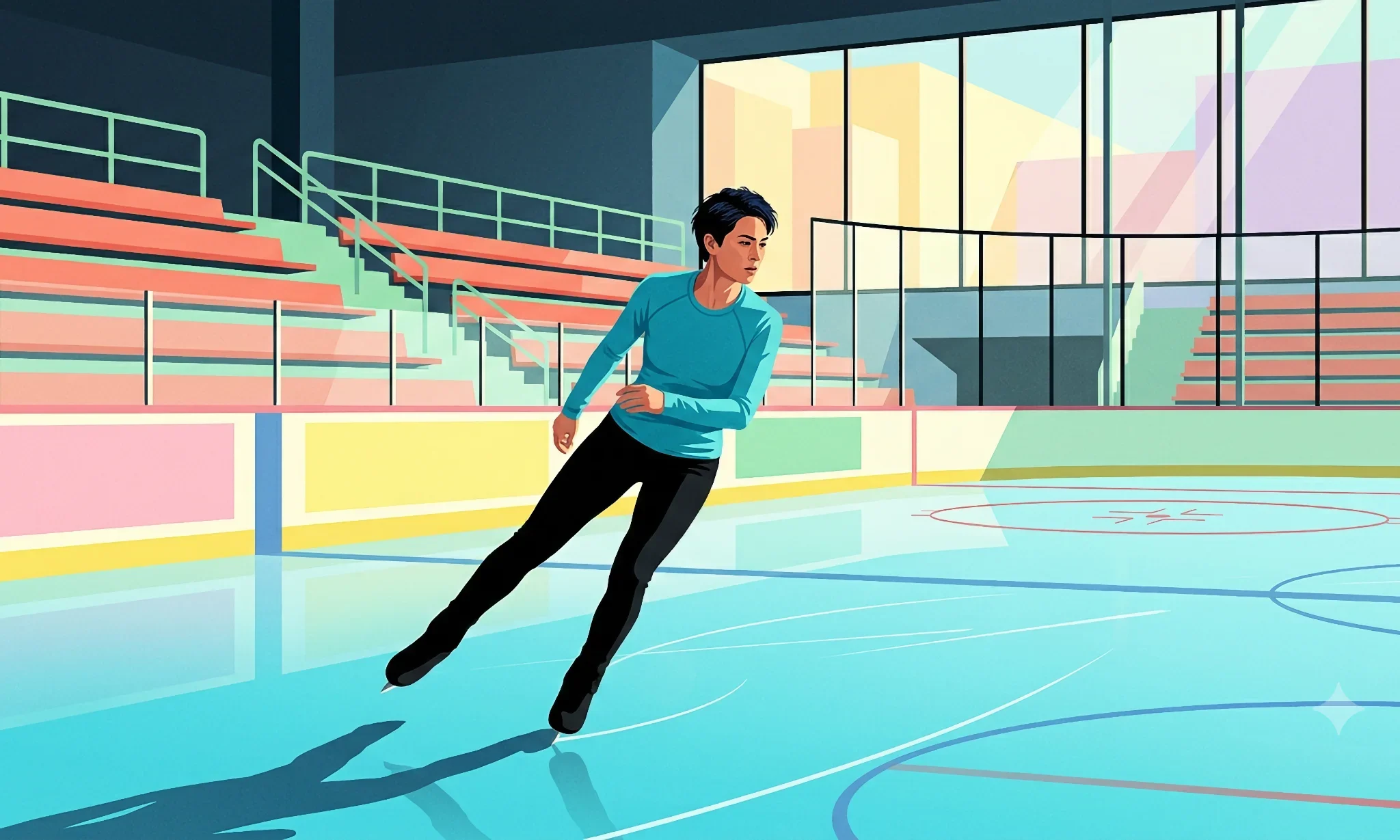
A woman walked into our rink last winter holding her work laptop bag, still in office clothes, and asked if it was "too late" to learn to skate. She was 34. She'd watched her daughter's lessons for two years from the bleachers and finally wanted to try it herself.
She was not too late. She's now testing toward Adult Bronze.
I get this question constantly — from people in their late 20s, their 40s, their 60s. Almost always with the same apologetic framing, as if wanting to learn a beautiful, difficult sport as an adult requires an excuse. It doesn't. But I want to give you the real picture of what adult skating looks like, because the romantic version ("it's never too late!") and the realistic version are both true, and you deserve both.
The honest starting point
Adult bodies and child bodies learn skating differently, and pretending otherwise does you no favors.
What works in your favor: You understand instruction. When I tell an adult student to "rotate from your core, not your shoulders," they can process and apply that immediately. A six-year-old needs that broken into a game. Adults also tend to have better body awareness, more patience for repetition, and — critically — they chose this themselves. That intrinsic motivation matters more than people realize.
What works against you: Fear. Adults fall differently than children — we tense up, we know exactly how much a hard landing will hurt, and that fear creates stiffness that actually causes more falls, not fewer. Children fall loose; adults fall braced, which is worse for joints. Adult bodies also take longer to adapt to new movement patterns and recover more slowly between sessions.
Neither of these cancels the other out. They just mean adult learning looks different — slower in some ways, faster in others — and a coach who understands that difference will get you further than one who teaches you exactly like they'd teach an eight-year-old.
What the first year actually looks like
Months 1-3: Basic skills. Most adults start in an Adult Learn-to-Skate group class or in private lessons covering the same fundamentals as the youth Basic Skills curriculum — forward and backward skating, stopping, simple turns, falling and getting up safely. This part humbles almost everyone. You will feel uncoordinated in a way you haven't felt since childhood, and that's normal, not a sign you're bad at this.
Months 3-8: Independence. Skating without holding the wall, basic crossovers, your first real edges. This is where most adults decide whether they're "in." The ones who stick with it past this point usually skate for years.
Months 8-18: First tests. Many adult skaters take their first Adult Pre-Bronze Moves in the Field test within their first year to eighteen months. It's a real milestone — an official U.S. Figure Skating credential, not a participation badge.
I want to be direct about something: progress is not linear, and adults often feel they're regressing around month four or five, right as the easy wins from total-beginner status run out and the actual hard technical work begins. This is universal. It is not a sign you started too late or that you're uniquely uncoordinated.
The Adult test track, explained
U.S. Figure Skating maintains a complete Adult Moves in the Field and Free Skate curriculum, parallel to the standard youth track but built around adult realities — different practice schedules, different physical starting points, different timelines.
The Adult MITF ladder runs Pre-Bronze → Bronze → Silver → Gold, each with its own required moves and judging criteria (the same four core criteria as the youth track: edge quality, power, extension, and continuous flow). Adult Gold is a genuine accomplishment requiring real mastery of edges and power — it is not an easier version of anything. I've written a complete guide to the Moves in the Field requirements at every level, including the full Adult track, with diagrams and a free practice workbook if you want to see exactly what each level demands.
Realistic timeline for the full Adult track, training 2-3 times per week: Pre-Bronze in your first year, Bronze in year two, Silver in year three to four, Gold somewhere in year four to six for most adults who train consistently. Some move faster. Plenty of wonderful skaters take longer and enjoy every year of it. There is no clock running against you here except the one you bring with you.
Yes, there's a competitive path — a real one
This surprises almost every adult who asks me about it: there is a complete, legitimate U.S. Figure Skating competitive structure for adults, with regional, sectional, and national championships.
The U.S. Adult Figure Skating Championships is the marquee event — held annually, open to skaters who qualify through Adult test levels, across multiple age divisions (typically grouped in 5-10 year brackets from 21+ up through 60+ and beyond). There are also Adult Sectional Championships at the regional level. I cover the confirmed dates for the current season in our full 2026-27 competition calendar, including this season's Adult Championships and Eastern Adult Sectionals.
Competing as an adult looks different from what you watched as a kid on television. You're not chasing an Olympic berth. You're skating against other adults at your level and age bracket, in events that feel more like a community than a battlefield — competitors warming up together, cheering for each other between groups, comparing notes on costumes afterward. Many adult skaters describe their first competition as one of the proudest days of their adult life, and I believe them every time.
What it actually costs
I won't dance around this. Adult skating is a real financial commitment, though typically more manageable than the youth competitive track because adults usually train fewer hours per week and don't need annual equipment replacement from growth.
Realistic annual range for an adult skating recreationally to moderately seriously: $3,000-$10,000, covering ice time, 1-2 private lessons per week, basic equipment, and occasional group classes. Adults pursuing the competitive track more seriously — more lesson frequency, off-ice training, competition entry and travel — run $8,000-$22,000 annually. I break down the full category-by-category math, including a free interactive calculator, in our complete cost guide — the Adult-track settings in that calculator will give you a number specific to your situation.
The single biggest lever you control: ice time scheduling. Adults who can train during off-peak hours (mid-morning weekdays, for instance) pay significantly less per hour than those locked into evening prime-time ice. If your schedule has any flexibility, use it.
The questions adults actually ask me
"What if I'm out of shape?" Start anyway. Skating itself builds the specific fitness it requires — balance, leg strength, core control — faster than almost any general fitness program builds it for you. You don't need to get in shape before you start. You get in shape by starting.
"Will I get hurt?" There's real injury risk, mostly from falls in the first year before your fall-and-recovery instincts develop. A good coach reduces this significantly by building your fundamentals — fall technique, edge control — deliberately and early, rather than rushing you onto skills you're not ready for. Wrist guards and padded shorts in the early months are not embarrassing; they're smart.
"I used to skate as a kid — does that help?" Enormously. Childhood skating builds a body memory that resurfaces faster than you'd expect, even after a 20- or 30-year gap. Returning adults often relearn in months what took them years originally.
"Is it too late for me to ever land a jump / get good edges / look like a real skater?" No. Adults regularly learn waltz jumps, salchows, even doubles with enough time and the right coaching. "Looking like a real skater" is a function of edge quality and posture, both of which are entirely learnable at any age — I've coached adults whose skating skills outpace many teenage competitors, because adults bring discipline and attention to detail that's harder to instill in a distracted 13-year-old.
"What if I'm the only adult at the rink?" You won't be. Adult skating has grown substantially in the U.S. over the last decade, and most rinks now run dedicated adult classes and adult freestyle sessions specifically because the demand is there. You're joining a community, not standing out as an anomaly.
How to actually start
Find Adult Learn-to-Skate or Adult Academy group classes at your local rink — nearly every USFS-affiliated rink runs them, typically meeting weekly. This is the lowest-commitment, lowest-cost way to find out if you love it before investing further.
Add a private lesson once you're hooked. Group classes teach the fundamentals; private lessons accelerate everything once you know you want to go further. Even one lesson every other week meaningfully speeds up technical correction that group classes can't address individually.
Rent before you buy. Don't purchase boots in your first months. Rental skates are perfectly fine while you determine your foot shape, skill trajectory, and whether this is a long-term commitment — usually around the three-to-six month mark.
Set a real goal, even a small one. "I want to skate backward by spring" or "I want to pass my Pre-Bronze test this year" gives your training shape and gives you something to feel proud of when you get there.
At Krigor Studio, we run Adult Academy sessions and individual coaching for adult skaters at every level — from someone who has genuinely never been on the ice to adults preparing for Adult Gold tests and Adult Sectional competition. Coached by 2-time Olympian Igor Lukanin and World Championship performer Kristen Fraser, with the same technical rigor we bring to our youth competitive program, adapted to where you're actually starting from.
A final thought
The woman with the laptop bag who asked if she was too late — I think about her question often, because it's really a question about permission. Adults don't typically need permission to start a new sport. But figure skating carries a particular cultural weight, an assumption that it belongs to childhood, to the Olympics, to people who started at four. That assumption is simply wrong.
You're not too late. You're not too old. You're not too uncoordinated. You're someone who wants to learn something difficult and beautiful, at exactly the right time for you to start: now.
Kristen Fraser-Lukanin & Igor Lukanin is a 2-time Olympian and co-founder of Krigor Studio in Montclair, NJ. He coaches adult skaters from absolute beginners through Adult Gold test level and Adult Sectional competition, alongside the studio's youth Single Skating, Solo Ice Dance, and Couples Ice Dance programs.
Related reading: