Solo Ice Dance Explained: One of the Fastest-Growing Disciplines in Figure Skating
QUICK NAVIGATION
📖 In this guide
Solo ice dance lets skaters compete, test, and reach the international level completely on their own. Here's what it involves, why it's growing, and whether it's right for your skater.
There's a discipline in figure skating that most casual fans have never heard of, that solves one of the sport's oldest problems, and that has been quietly growing faster than almost anything else in American skating. It's called solo ice dance, and if your child loves the artistry of ice dance but you've been told they need a partner to pursue it — this article is going to change how you think about their options.
I've coached ice dance at every level, from developmental to international. I've watched families spend years searching for partners that never materialized. And I've watched solo ice dance transform from a niche workaround into a legitimate, internationally recognized competitive path. Let me explain what it actually is, why it's growing so fast, and whether it might be right for your skater.
The short version
Solo ice dance is ice dance performed by one skater, without a partner. The skater executes the same pattern dances and a free dance program — the core of the ice dance discipline — entirely on their own, and competes individually against other solo dancers at their level.
It is a fully recognized U.S. Figure Skating discipline with its own competition series, national championship, and now an international competitive circuit. It is open to skaters of all ages and all levels, from preliminary through gold and international.
And critically: it gives skaters the entire ice dance discipline — the edges, the musicality, the rhythm patterns, the artistry — without requiring them to find, fund, and maintain a partnership.
What solo ice dance actually involves
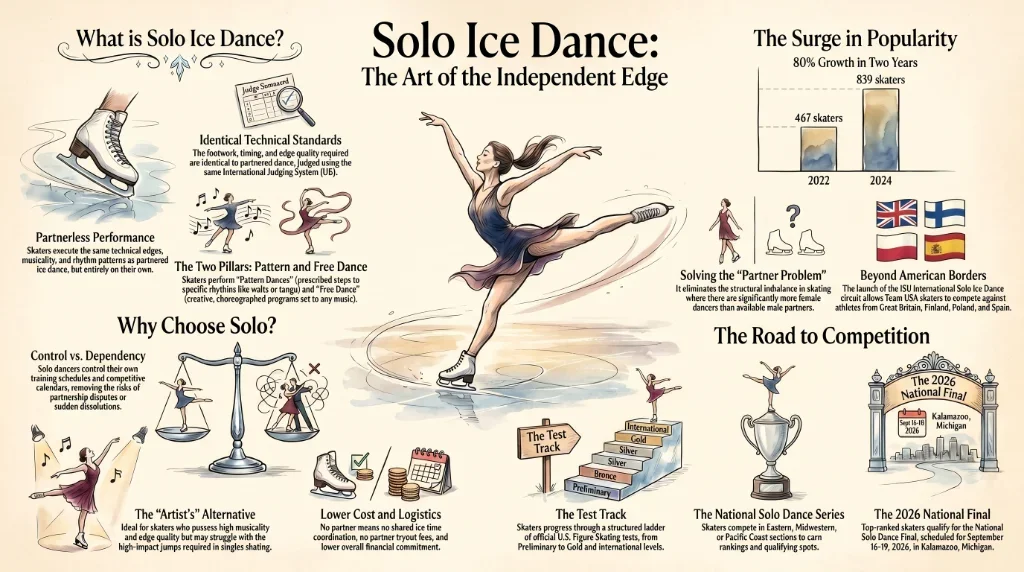
Solo ice dance mirrors partnered ice dance almost exactly. The same two event types make up the discipline.
Pattern dances. These are the foundation of all ice dance. A pattern dance is a prescribed sequence of steps, edges, and turns skated to music of a specific tempo and rhythm — a waltz, a tango, a foxtrot, a blues, and so on. The pattern is precisely defined: which foot, which edge, which turn, on which beat of music. In partnered dance, two skaters execute these patterns together in hold. In solo dance, one skater executes the same patterns alone. The footwork is identical. The technical demands — edge quality, timing, rhythm, flow — are the same.
Free dance. This is the creative, choreographed program set to music of the skater's choosing within the rules of their level. In partnered ice dance, the free dance includes lifts, twizzles in unison, and dance spins. In solo ice dance, the free dance is adapted for a single skater — the choreography is redesigned to suit a solo performer, with required elements appropriate to skating alone. The result is a program that showcases the same artistry and musicality as partnered free dance, reimagined for one body on the ice.
Both event types are judged using the International Judging System (IJS) — the same scoring framework used across competitive figure skating — which means solo dancers receive technical and component scores exactly as other competitive skaters do.
Why it's growing so fast
The growth in solo ice dance isn't a marketing claim — it's in the registration numbers. U.S. Figure Skating's National Solo Dance Series has seen its participation climb steadily, and recently, sharply. In 2022, 467 skaters registered for the series. In 2023, that number jumped to 774 — a roughly 40% increase in a single year. By 2024, registration reached 839 skaters. For a discipline that started as a small pilot program just over a decade ago, that trajectory is remarkable.
There are several reasons for this surge.
It solves the partner problem. Ice dance has a structural imbalance that has frustrated families for decades: there are far more girls who want to ice dance than there are boys to partner them. A talented female ice dancer could reach a high test level and then find herself with nowhere to go — no partner, no path forward. Solo ice dance removes that ceiling entirely. A skater can pursue ice dance as far as their ability takes them, partner or no partner.
It's lower-cost and lower-logistics than couples dance. No partner means no shared ice time to coordinate across two families, no partner tryouts, no partnership disputes, no risk of a partnership dissolving and ending a competitive season. A solo dancer controls their own schedule, their own training, and their own competitive calendar.
It went international. For years, solo dance was sometimes dismissed as an American phenomenon. That's changing. The inaugural ISU International Solo Ice Dance season launched recently, with international events featuring skaters from countries including Great Britain, Poland, Spain, and Finland.
It keeps skaters in the sport. This is the reason that matters most to me as a coach. Solo ice dance gives skaters a reason to stay — a competitive path, a community, a goal to chase — when they otherwise might have aged out of singles or abandoned dance for lack of a partner. U.S. Figure Skating has been smarter than most national federations in recognizing solo dance as a tool to retain skaters, and the discipline's growth reflects that wisdom.
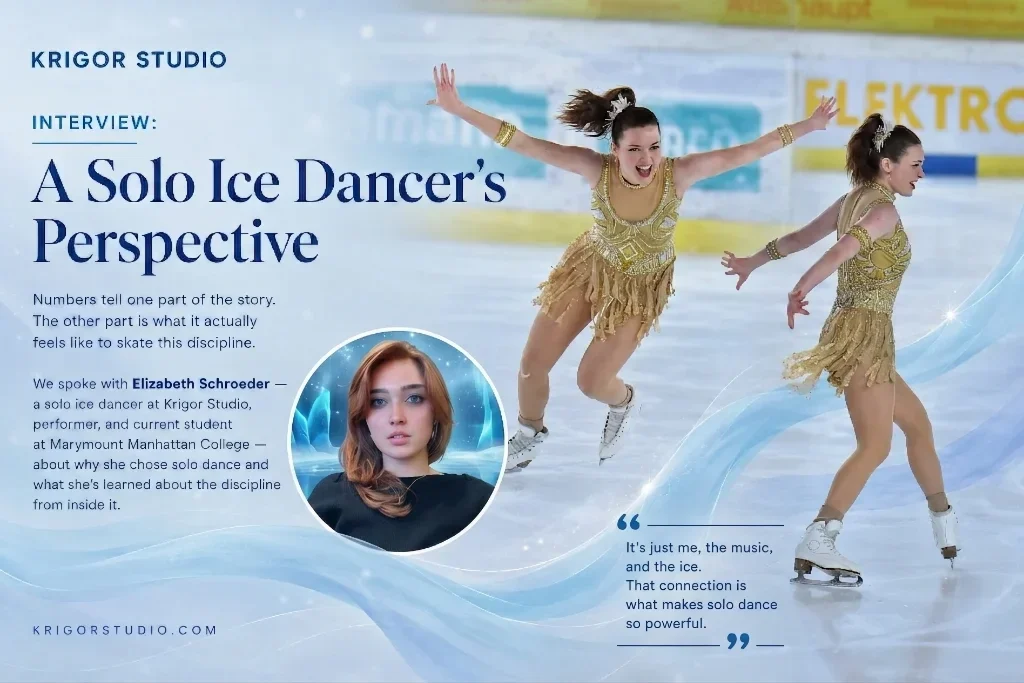
Elizabeth Schroeder, solo ice dancer and Krigor Studio student
Interview: A Solo Ice Dancer's Perspective
Numbers tell one part of the story. The other part is what it actually feels like to skate this discipline. We spoke with Elizabeth Schroeder — a solo ice dancer at Krigor Studio, performer, and current student at Marymount Manhattan College — about why she chose solo dance and what she's learned about the discipline from inside it.
What drew you to solo dance?
"Even though I came to solo dance later in my skating career, every day I really feel like ice dance was something for me to discover all along. Some of the skaters I admire most are ice dancers, so it was a facet of skating I'd always been curious about."
What do you love most about it?
"I love the combination of artistic expression and focus that needs to be shown through every move. So many people think ice dance is easier because we don't have triple axels or quads, but ice dance is so much more. Every moment of your programs and patterns must be thought out and done very well. I love ice dance because there is intention behind everything, and you constantly have to be aware of your body."
What surprised you about the discipline?
"How much I would love it. I wanted to be a figure skater originally because I purely loved skating around the rink and jumping — and I was a jumper, for sure. The more I got into ice dance, the more I realized how much I had to offer as a skater. I became so invested that I journal and set goals for myself daily, and I visualize many of the skaters I look up to in ice dance with the eye that I have now. Going into solo dance gave me a new — and possibly bigger — love for skating."
What would you tell a skater who's considering it?
"First of all: ice dance is hard. So as long as you really love skating and you're willing to put in the work — and even go above and beyond — then go for it."
What's your goal in the sport this season?
"I'm in my first season of solo dance, so my goal is to place on the podium this year at Nationals. My goal is to prioritize my skating and my body to prepare me for these upcoming competitions, and to put out programs I'm really proud of."
Elizabeth Schroeder is a solo ice dancer training at Krigor Studio. Follow her skating journey on Instagram @elizabethmschroeder and TikTok @schroeder_skates.
Who solo ice dance is right for
In my experience, solo ice dance is an excellent fit for several types of skaters.
The artistic skater who isn't a jumper. Some skaters have beautiful edges, natural musicality, and a feel for performance — but jumping isn't their strength and never will be. Singles skating, which is driven by jumps at the competitive level, can be frustrating for these skaters. Solo ice dance lets them build their entire competitive identity on what they're actually good at: edge quality, rhythm, and interpretation.
The dancer who can't find a partner. This is the classic case. A skater loves ice dance, has the technical foundation, but there's no partner available at their level in their region. Rather than abandoning the discipline they love, they pursue it solo — and many discover they prefer the independence.
The skater who wants control over their own path. Couples ice dance ties your progress to another person's schedule, family, commitment, and continued participation. Some skaters and families simply don't want that dependency. Solo dance gives them a competitive discipline they fully control.
The adult skater. Solo ice dance is open to all ages, and it's a wonderful path for adult skaters who love dance but have no realistic prospect of building a competitive partnership. Adults can test and compete in solo dance through the standard and adult tracks.
The transitioning singles skater. Skaters who started in singles but are drawn to the artistry of dance — or whose bodies are signaling that years of jumping are taking a toll — often find solo ice dance to be a graceful and rewarding second act in their skating careers.
How solo dance competition works
The competitive structure of solo ice dance is built around the U.S. Figure Skating National Solo Dance Series.
The series. The Solo Dance Competition Series runs across three sections of the country: Eastern, Midwestern, and Pacific Coast. Each section hosts its own designated series competitions throughout the season, offering both pattern dance and free dance events. Skaters register for the series — typically by an April deadline — and their competitive level is set based on their test level at registration.
Qualifying for nationals. Skaters compete at series events and are ranked based on their IJS scores. Strong finishers in each section earn invitations to the National Solo Dance Final, the discipline's championship event. Skaters can compete in events outside their home section, but the series rules govern how many competitions are required to qualify. The 2026 National Solo Dance Final is scheduled for September 16-19, 2026, in Kalamazoo, Michigan.
Non-qualifying opportunities. Beyond the series, solo dance pattern and free dance events are offered at non-qualifying competitions across the country. A skater doesn't have to chase nationals to compete — there are abundant opportunities to participate purely for the experience and the personal challenge.
The international path. The international path. With the launch of the ISU International Solo Dance circuit, solo dancers now have direct access to international competition opportunities. Under the current structure established by the ISU International Solo Dance Committee, eligible skaters may enter international solo dance events without a national selection process. At present, participation is open, allowing skaters to register and compete internationally while gaining valuable experience and exposure on the world stage. However, as the discipline continues to grow, national qualification or selection procedures may be introduced in the future as participation expands and competition opportunities evolve.
The test track
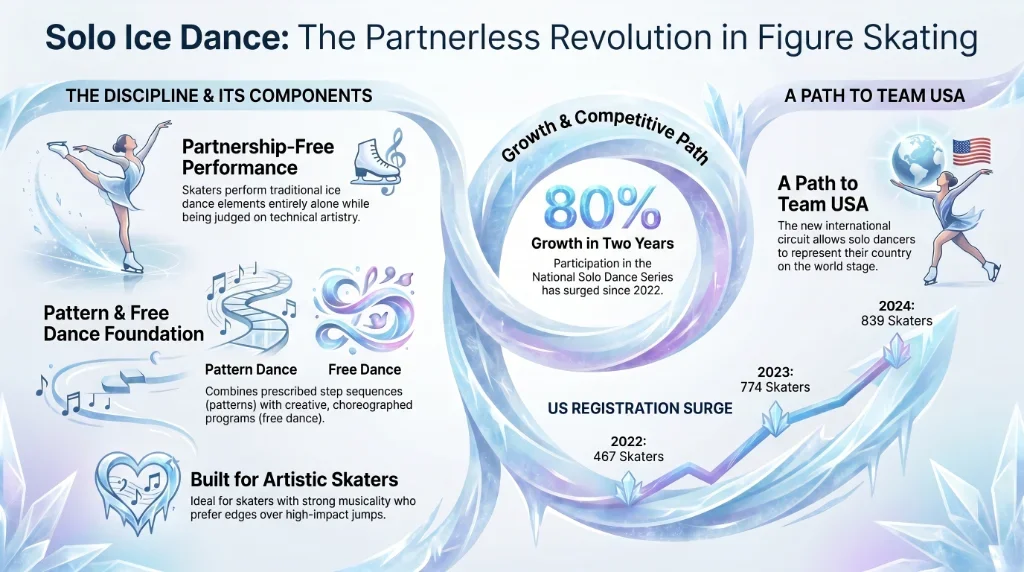
Solo ice dance follows the U.S. Figure Skating ice dance test structure. Skaters progress through pattern dance tests and free dance tests, the same way partnered dancers do, advancing from preliminary through the higher levels.
One important detail families should understand: U.S. Figure Skating asks skaters to choose between the partnered pattern dance test track and the solo pattern dance test track — and skaters generally cannot switch back and forth between the two. This is a meaningful decision, and it's worth discussing carefully with your coach before committing to one track. Each year, thousands of pattern dance tests are passed by U.S. Figure Skating members across both tracks, so whichever path a skater chooses, they're joining a large and active testing community.
The test track gives solo dancers exactly what every figure skater needs: clear, measurable milestones, official credentials recognized nationwide, and a structured progression that turns a love of dance into demonstrable accomplishment.
Solo dance vs. couples ice dance: an honest comparison
Families often ask me which is "better." Neither is better. They're different paths with different tradeoffs.
Couples ice dance is the classical Olympic discipline. It offers the full expression of ice dance — partner lifts, the visual poetry of two bodies moving as one, the path to the U.S. Championships and ultimately the Olympics. But it requires a partner, with everything that entails: the search, the cost-sharing, the logistical coordination, the interpersonal complexity, and the real risk that a partnership ends and a competitive path collapses with it.
Solo ice dance offers the discipline's artistry, technique, and a genuine competitive structure — national series, national final, international circuit — without the partnership dependency. The tradeoff is that it does not lead to the Olympic ice dance podium, which remains a couples-only event. For the vast majority of skaters, who were never on an Olympic trajectory anyway, this tradeoff costs them nothing real and gives them enormous freedom.
My honest guidance to families: if your skater has a realistic shot at elite couples competition and you can support the partnership, couples ice dance is a remarkable path. For nearly everyone else who loves dance, solo ice dance is the more practical, more controllable, and often more joyful choice. It is not a consolation prize. Some of the most fulfilled dancers I've ever coached chose solo dance on purpose and never looked back.
How to get started
If solo ice dance sounds like a fit for your skater, the path in is straightforward.
First, your skater needs a foundation in skating skills — the edges, turns, and control built through Moves in the Field or Skating Skills testing. Solid edge quality is the bedrock of all ice dance.
Second, find a coach who knows ice dance. Not every coach does. Dance is a specialized discipline with its own technique, its own culture, and its own competitive structure. A coach with genuine ice dance experience will introduce your skater to their first pattern dances, guide the test-track decision, and help build toward series competition when the skater is ready.
Third, start with pattern dances. The pattern dances are where every ice dancer begins. They build the rhythm, timing, and edge quality that everything else in the discipline rests on.
A discipline worth knowing about
Solo ice dance is one of the best things to happen to American figure skating in the last fifteen years. It has opened a real competitive path to thousands of skaters who would otherwise have hit a wall. It has kept skaters in the sport. It has grown a community. And it is still expanding, now onto the international stage.
If your skater loves the artistry of dance — the music, the edges, the feeling of interpreting a rhythm on the ice — solo ice dance deserves a serious look. The partner they thought they wanted? They may not need one at all.
At Krigor Studio, we coach solo ice dance at every level, from a skater's first pattern dance through series and national-level competition. Coached by 2-time Olympian Kristen Fraser and Igor Lukanin, we bring elite ice dance experience to skaters of all ages and ambitions.
Schedule a Free Consultation →
Whether your skater wants to compete at the National Solo Dance Final or simply explore the discipline for the joy of it, we'd love to help them take the first step.
Frequently asked questions
-
Solo ice dance is an independent discipline in figure skating where skaters can compete, test, and even reach the international level completely on their own, combining the artistry, musicality, and edge quality of traditional ice dance without the stress of finding and maintaining a partner.
-
Yes. For years, solo dance was sometimes dismissed as an American phenomenon, but that's changing — the inaugural ISU International Solo Ice Dance season launched recently, with international events featuring skaters from countries including Great Britain, Poland, Spain, and Finland.
-
Solo ice dance is an excellent fit for several types of skaters: the artistic skater who isn't a jumper, the dancer who can't find a partner, the skater who wants control over their own path, the adult skater, and the transitioning singles skater.
-
Solo ice dance does not lead to the Olympic ice dance podium, which remains a couples-only event. For the vast majority of skaters who were never on an Olympic trajectory anyway, this tradeoff costs them nothing real and gives them enormous freedom.
-
First, your skater needs a foundation in skating skills — the edges, turns, and control built through Moves in the Field or Skating Skills testing. Second, find a coach who knows ice dance. Third, start with pattern dances, where every ice dancer begins.
Kristen Fraser & Igor Lukanin is a 2-time Olympian and co-founder of Krigor Studio in Montclair, NJ. He coaches Single Skating, Solo Ice Dance, and Couples Ice Dance for skaters of all ages, from first steps through international competition.
Related reading: