How Figure Skating Scoring Works: GOE, PCS & IJS Explained
QUICK NAVIGATION
📖 In this guide
How figure skating scoring actually works — TES, GOE, PCS, and deductions explained with real base value tables, plus why a fall doesn't always cost the win.
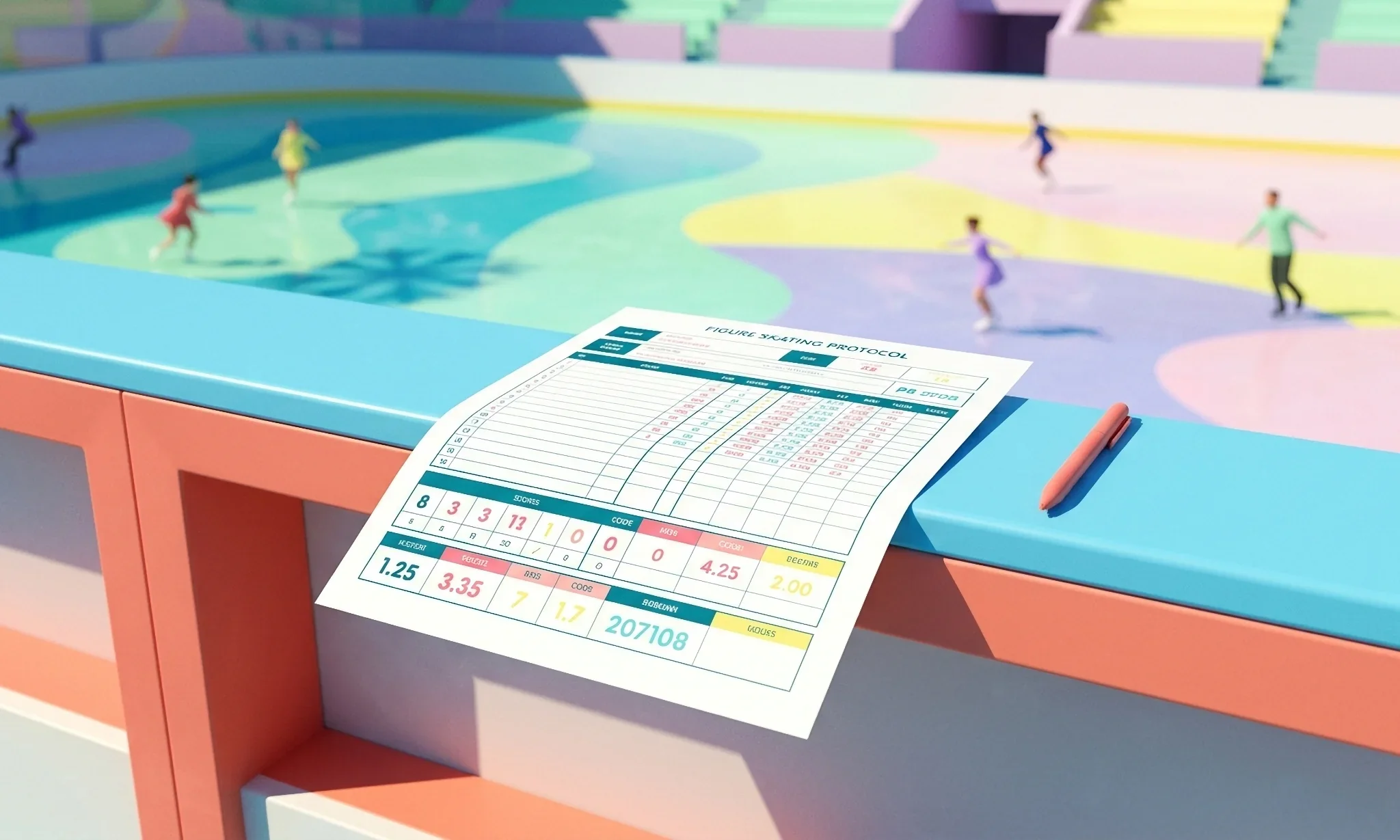
A mother cornered me at the boards after Regionals last season, program printout in hand, absolutely certain the system was broken. "She skated clean. The other girl fell. And she still scored higher than us. How does that make sense?"
I've had a version of this conversation at every rink I've coached at for twenty years. And the honest answer is: the system isn't broken — it's just not built the way most people assume. Figure skating hasn't been scored on "who skated best today" since 2004. It's scored on an accumulating point system with two separate scores added together, and once you understand those two scores, results that look baffling on the leaderboard start making complete sense.
This is the explainer I wish every skating parent got on day one of competing — not the simplified TV-commentary version, but the actual mechanics, with the real numbers.
The system in one sentence
Every figure skating score under the modern judging system — used at the Olympics, Worlds, and every U.S. Figure Skating qualifying event — is the sum of two independent scores minus any deductions:
Total Segment Score = Technical Element Score (TES) + Program Component Score (PCS) − Deductions
That's it. That's the whole architecture. Everything else in this article is detail underneath those three pieces. This is called the International Judging System (IJS), and it replaced the old "6.0" system in 2004 — a direct response to the judging scandal at the 2002 Salt Lake City Olympics, where the previous system's reliance on subjective rank-ordering by judges made vote-trading nearly undetectable. The IJS was built specifically to make scoring transparent and auditable: every point on a protocol sheet traces back to a specific rule (U.S. Figure Skating's official Scoring System page has the full technical breakdown).
Here's the part that trips up the mother at the boards: the two skaters in her example didn't fail or pass a shared standard. They each accumulated points independently, from different elements, executed with different quality. A skater who falls on a triple Lutz can still out-score a skater who lands a clean double Axel, because the Lutz — even botched — carries a much higher base value. Difficulty and execution are counted separately, and difficulty often wins the math.
Part one: the Technical Element Score (TES)
Every jump, spin, step sequence, and lift in a program has a base value — a fixed number of points set by the ISU before anyone skates, based purely on difficulty. A technical panel (not the judges) watches each element in real time, identifies exactly what was performed, and assigns that base value. Then the judging panel scores how well it was executed, using a Grade of Execution (GOE) from −5 to +5, which adjusts the base value up or down.
TES = Σ (Base Value ± GOE adjustment) for every element in the program
Jump base values, 2025–26 season
This is the table that explains 90% of the "why did that score more" questions. Notice how sharply value climbs with each added rotation — and how the six jump types are not equal at the same rotation count.
| Jump | Type | Double | Triple | Quad |
|---|---|---|---|---|
| Toe Loop | Toe | 1.30 | 4.20 | 9.50 |
| Salchow | Edge | 1.30 | 4.30 | 9.70 |
| Loop | Edge | 1.70 | 4.90 | 10.50 |
| Flip | Toe | 1.80 | 5.30 | 11.00 |
| Lutz | Toe | 2.10 | 5.90 | 11.50 |
| Axel | Edge | 3.30 | 8.00 | 12.50 |
Source: U.S. Figure Skating Scoring Guide, 2025-26 Scale of Values (ISU Communication No. 2707)
A few things worth knowing from this table alone:
The Axel is worth more than every other jump at the same rotation count, because it's the only jump taken off forward — a half-rotation harder than it looks (a "double Axel" is actually 2.5 rotations, not 2).
Toe jumps (Toe Loop, Flip, Lutz) use the toe pick to assist takeoff; edge jumps (Salchow, Loop, Axel) launch from a curve in the blade alone, with no toe assist — which is part of why edge jumps are typically harder to learn cleanly.
Combinations matter for strategy. In a jump combination, the first jump earns its full base value, but the second and third jumps earn full base value with only 80% of their GOE weighted — which is why you'll see skaters plan combinations (like a triple Lutz–triple toe loop) to bank the highest base values first.
Second-half bonus: since 2018, the last jump pass in the short program's second half, and the last three jump passes in the free skate's second half, earn a 10% base value bonus — the ISU's way of rewarding skaters who don't front-load all their hardest jumps while fresh.
Grade of Execution (GOE): the quality multiplier
Once the base value is set, each of the (typically) nine judges scores the quality of that specific element from −5 to +5. The highest and lowest marks are trimmed off, and the rest are averaged — a "trimmed mean" designed to blunt the effect of one biased judge. That average GOE is converted to a percentage of the base value and added or subtracted.
The critical detail parents miss: GOE is not a flat number added to every jump equally — it's a percentage of that jump's own base value. A +5 GOE on a quad Lutz (base value 11.50) is worth far more raw points than a +5 GOE on a double Lutz (base value 2.10), because +5 GOE adds roughly 50% of the base value. This is exactly why a slightly shaky quad often still outscores a picture-perfect double — the ceiling and the floor are both higher on harder jumps.
Judges evaluate GOE against specific published criteria. For jumps, positive GOE comes from:
| GOE factor | What judges are watching for |
|---|---|
| Air position & rotation | Good height, extension, and clean rotation speed |
| Takeoff and landing | Effortless takeoff, secure one-foot landing with knee bend |
| Flow | Speed maintained into and out of the element |
| Difficulty add-ons | Unusual entries/exits, matching arm or leg positions, difficult combinations |
Negative GOE comes from the opposite: labored takeoffs, under-rotation, two-foot or hand-down landings, or a fall — which triggers both a large negative GOE and a separate deduction (more on that below). The full published criteria live in ISU Communication No. 2701, updated each season.
Part two: the Program Component Score (PCS)
If TES answers "what did the skater do, and how well," PCS answers "how good was the program, as a whole piece of skating and performance." This is where artistry, edge quality, and choreography live — and it's the part most casual viewers assume is "just the judges' opinion," when it's actually scored against specific written criteria, just like GOE.
Since the 2022-23 season, the ISU consolidated what used to be five separate components into three:
| Component | What it evaluates | Replaced (pre-2022) |
|---|---|---|
| Skating Skills | Edge quality, power, speed, ice coverage, multi-directional skating, flow between elements | Skating Skills (unchanged) |
| Composition | How the program is structured — use of the ice surface, pattern design, how movement relates to the music's structure | Transitions + Choreography |
| Presentation | Musicality, timing, expression, and how the performance is projected to the audience | Performance + Interpretation |
Each judge scores each component from 0.25 to 10.00 in increments of 0.25. As with GOE, the high and low scores are trimmed and the rest averaged. That average is then multiplied by a factor that varies by discipline and segment — set specifically so that the total PCS lands in a similar range to the TES for that segment, keeping technical and artistic scoring roughly balanced rather than letting one dominate. (Skate Canada's public breakdown of the 2022 PCS factor changes is a clear reference if you want the full factor tables by level.)
Deductions: the subtractions everyone sees, few understand
Deductions are applied by the referee after TES and PCS are totaled, and they're the most visible — and most misunderstood — part of a protocol sheet.
| Infraction | Deduction |
|---|---|
| Fall (1st and 2nd, senior singles) | −1.00 each |
| Fall (3rd and 4th) | −2.00 each |
| Fall (5th or more) | −3.00 each |
| Time violation (program too long/short) | −1.00 per 5 seconds over/under |
| Costume or prop violation | −1.00 |
| Illegal element or movement | −2.00 |
| Interruption in program | −5.00 |
This is the answer to the mother at the boards: her skater's competitor fell, ate a −1.00 deduction and a heavy negative GOE on that one jump — but if the rest of that skater's program included a technically harder layout with strong GOE elsewhere, and stronger PCS, the totals can still land in her favor. A fall costs a lot, but it costs a fixed amount; it doesn't zero out an otherwise stronger program.
Putting it together: a simplified worked example
Here's a stripped-down illustration (not a real protocol) showing how the pieces stack for one jump element:
| Element | Base Value | GOE avg. | GOE points | Element score |
|---|---|---|---|---|
| Triple Lutz (clean, strong) | 5.90 | +3 | +2.36 | 8.26 |
| Triple Lutz (under-rotated, 2-foot landing) | 5.90* | −3 | −2.36 | 3.54 |
*Base value shown before any technical-panel downgrade for under-rotation.
Same jump attempted, roughly a 4.7-point swing based purely on execution — before a single artistic mark is even considered. Multiply that swing across 7 elements in a short program or up to 12 in a free skate, and it's easy to see how two skaters attempting similar content can land 15-20 points apart.
IJS vs. the old 6.0 system
You'll still hear the 6.0 system referenced — mostly by TV commentators reminiscing, or at lower-level domestic events.
| IJS (current) | 6.0 System (legacy) | |
|---|---|---|
| Used since | 2004 (all ISU/Olympic/USFS qualifying events) | 1901–2004 internationally; still used at some U.S. non-qualifying club events |
| Score type | Open-ended cumulative points | Two marks out of 6.0 |
| Technical scoring | Per-element base value + GOE | One holistic "Technical Merit" mark |
| Placement | Highest total points wins | Majority ordinal ranking among judges |
| Where you'll still see it | Rarely — mostly historical footage | Compete USA and some pre-juvenile/local club events |
If your skater is testing or competing at the earliest club levels, don't be surprised to see a 6.0-style scoresheet at a local Compete USA event even in 2026 — both systems still coexist in U.S. domestic skating, and it's worth asking your rink's competition organizer which one a given event uses before you walk in. (We cover what to expect walking into your first official evaluation in our guide to what a USFS test session actually is.)
The most common misunderstanding, cleared up
"She got a 5.9 in her program" doesn't mean anything under the current system — that language is a relic of the retired 6.0 scale. Today's scores are open-ended: a strong senior free skate might total well over 200 points, while a Juvenile-level program might total 30. There's no ceiling, and there's no "perfect score" to chase — only your skater's own protocol sheet, improving segment over segment. That reframing alone changes how most families experience competition day: stop comparing your skater's raw number to what you remember from Olympic broadcasts, and start comparing it to their own last event.
Why understanding this actually helps your skater
This isn't trivia for its own sake. Coaches use the scoring breakdown constructively, and so should parents:
It explains training priorities. If your skater's PCS consistently trails their TES, that's a direct signal to invest more in off-ice artistry, edge work, and choreography — not more jump repetition.
It reframes a "disappointing" score. A protocol sheet showing strong GOE on easier content but weak GOE on harder attempts tells you exactly where the next training block should focus.
It sets realistic competition goals. "Land the combination clean" is a better goal than "beat so-and-so," because your skater controls their own base values and GOE — not what anyone else does on the ice that day.
Frequently asked questions
-
GOE stands for Grade of Execution — a quality score from -5 to +5 that judges apply to every technical element (jumps, spins, step sequences). It's converted to a percentage of that element's base value and added or subtracted, so GOE has a much bigger point impact on harder elements than easier ones.
-
PCS stands for Program Component Score. It evaluates the overall quality of a program across three components — Skating Skills, Composition, and Presentation — separate from the individual jump and spin scores in the Technical Element Score (TES).
-
Because TES and PCS are additive, not comparative. A fall costs a fixed deduction (-1.00 for a first fall in senior singles) plus negative GOE on that one element — but the rest of a harder, higher-base-value program can still outscore a clean but easier layout.
-
No. The 6.0 system was retired internationally in 2004 after the 2002 Salt Lake City judging scandal and replaced by the International Judging System (IJS), which uses open-ended cumulative points. Some U.S. non-qualifying club events still use 6.0-style scoring locally.
-
There isn't one. The IJS is open-ended — scores accumulate from base values and GOE with no fixed ceiling, unlike the old 6.0 system's maximum of 6.0 per mark.
-
Typically nine judges score GOE and program components at major international events, with the highest and lowest marks trimmed before averaging the rest. A separate technical panel — not the judges — identifies each element and its base value.
A final thought
The scoring system looks intimidating on a printed protocol sheet — rows of abbreviations, decimals, plus and minus signs. But underneath it is a genuinely fair idea: reward difficulty, reward quality of execution, and reward artistry, each measured on its own terms and added together in the open. Once a family understands that architecture, competition days get calmer. You stop reading results as a verdict on whether your child is "good," and start reading them as exactly what they are — a detailed, specific map of what to work on next.
Kristen Fraser & Igor Lukanin is a 2-time Olympian and co-founder of Krigor Studio in Montclair, NJ, where skaters train across the full USFS competitive pathway.
Related reading: