How to Choose Your First Figure Skates: A Parent's Buying Guide
Double-click to edit...
QUICK NAVIGATION
📖 In this guide
Rent or buy, boot stiffness explained by level, how a proper fit should feel, blades and toe picks, budget ranges, and the two mistakes that cause most first-timer problems.
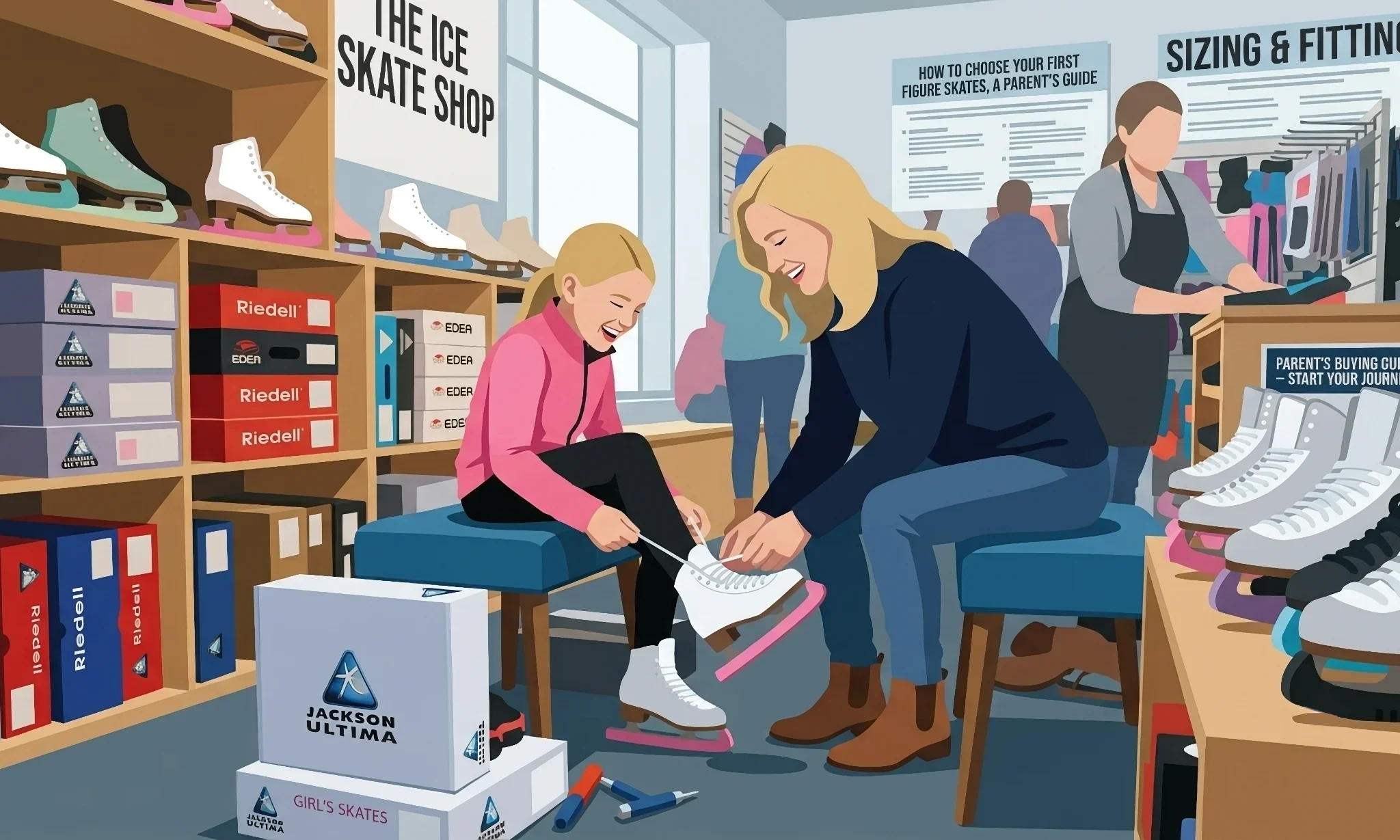
A dad once showed up to his daughter's third lesson holding a brand-new pair of boots — stiff, gleaming, and expensive. He'd done his research, read that "good boots matter," and bought what the pro shop's top shelf had to offer. His daughter, six years old and three weeks into learning to glide, could barely bend her ankles in them. She spent the next two months fighting her own equipment before we got her re-fitted into something appropriate for where she actually was.
This happens constantly, in both directions. Some families overspend on boots too stiff and advanced for their skater's level. Others stay in flimsy rental skates for a year past the point where it's holding their child back. Both mistakes come from the same place: nobody explained what actually matters when choosing figure skates, and the industry doesn't always volunteer it.
Here's the guide I give every family at Krigor Studio before their first purchase.
Rent or buy: how to know when it's time
Almost every skater should start in rental skates, and there's no shame in that — rentals exist for a reason, and buying too early wastes money on boots your child will outgrow before they've earned the support level.
The signal to switch to owned skates isn't a certain number of weeks — it's a combination of frequency and commitment:
Skating more than once a week, consistently, for at least a month or two. If lessons have become a regular part of the schedule rather than a trial, rental skates start actively working against progress — dull blades and generic ankle support make it harder to feel edges cleanly.
Your skater has said, unprompted, that they want to keep going. This is worth waiting for. Buying before a child has expressed real interest is one of the most common ways families end up with unused equipment in a closet.
They've outgrown what rentals can offer technically. Once a skater starts working on crossovers, backward edges, or their first single jumps, rental skates — with their soft, generic support and blunt blades — genuinely limit what's possible to learn.
If you're unsure, ask your rink's coach directly. A good coach will tell you honestly whether your child is ready for owned skates or whether another few weeks in rentals makes more sense — they have nothing to gain either way, and the honest ones will say so.
Boot stiffness, explained by level
This is the single most misunderstood concept in buying skates, and it's the direct cause of the dad-with-the-stiff-boots story above.
Boot stiffness is a rating (roughly 0-100+ depending on manufacturer scale) describing how much the boot resists ankle flex. It is not a proxy for quality — a stiffer boot is not simply "better." Stiffness needs to match what a skater's ankles and muscles can actually control at their current level.
Why this matters mechanically: a beginner still developing ankle strength and balance needs some ankle flexion to learn proper knee bend, edges, and stroking technique. A boot that's too stiff locks the ankle rigid, which prevents a beginner from learning correct form and can actually be more dangerous — kids compensate with poor technique elsewhere, or lose balance because they can't make the small ankle adjustments beginners rely on. On the other end, a boot too soft for an advancing skater breaks down fast and can't absorb the landing forces of jumps, leading to instability and, over time, overuse injuries.
| Skater Level | Boot Stiffness | What They're Working On |
|---|---|---|
| Beginner (Basic 1-6 / Snowplow Sam) | Soft (roughly 20-35) | Balance, gliding, stopping, basic edges |
| Basic Freestyle (Pre-Preliminary to Pre-Juvenile) | Medium (roughly 40-55) | Crossovers, backward skating, first single jumps |
| Intermediate (Juvenile to Intermediate) | Firm (roughly 55-70) | Consistent single and double jumps, spin variations |
| Advanced / Competitive (Novice and above) | Stiff (70-90+) | Doubles, triples, advanced spin positions |
Stiffness numbering varies by manufacturer and isn't standardized across brands — a "50" in one brand may flex differently than a "50" in another. This is exactly why fitting in person, on ice if possible, matters more than shopping by spec sheet alone.
A good rule of thumb from experienced fitters: when in doubt, size down in stiffness, not up. A skater in a slightly-too-soft boot can usually still learn correctly, just with a shorter boot lifespan. A skater in a too-stiff boot can develop compensating habits that a coach then has to spend months correcting.
The fit test every parent should know
Fit matters more than brand, more than stiffness, more than price. A perfectly fitted mid-range boot outperforms a premium boot that doesn't match your child's foot shape.
Here's what a proper fit should feel like, and the checks any pro shop fitting should include:
Snug, not painful. Figure skates typically run 1-2 sizes smaller than street shoes. Toes should lie flat and just graze the front of the boot — enough room to wiggle slightly, no more.
The heel-lift test. This is the single most important check. With the boot laced, have your skater rise up onto their toes. If the heel lifts inside the boot, it's too big — full stop, regardless of how the rest of it feels. A locked-down heel is non-negotiable for control.
No pressure points on the ankle bones. Sharp, localized pain (as opposed to general newness discomfort) usually means the wrong boot shape for that foot, not a sizing issue — this is where trying a second brand often solves what tightening laces can't.
Heat-moldable boots are common in mid-to-upper price tiers now. A skate tech heats the boot and molds it to your child's foot while warm, which solves a lot of shape-mismatch problems that used to require months of painful breaking-in.
Different brands fit different foot shapes — this matters as much as any spec. As a general (not universal) starting point: Jackson tends to run wider and suits average-to-wide feet; Edea tends to run narrower and lighter; Riedell and Graf fall in between with model-by-model variation. The only way to know for certain is trying boots on, ideally on ice, at a proper pro shop rather than ordering blind online for a first pair
Blades and toe picks
Most beginner and intermediate skates come as pre-mounted boot-and-blade sets, which is the right call for a first pair — buying boot and blade separately and having them professionally mounted is an advanced-skater decision, not a beginner one.
A few things worth knowing about the blade itself:
Toe pick size scales with what your skater does. Smaller, straighter picks suit beginners and ice dance; larger, more aggressive cross-cut picks assist with the toe-vault needed for jumps like the toe loop, flip, and Lutz as skaters progress.
Blade rocker (the curve from toe to heel) affects turning radius — figure skate blades have significantly more rocker than hockey or speed skates, which is what makes tight spins and turns possible.
Sharpening hollow (the groove ground into the blade's underside) is typically deeper/more forgiving for beginners and shallower for advanced skaters chasing sharper grip — your pro shop will adjust this at each sharpening as your skater progresses.
For a first pair, don't overthink the blade — a quality boot-and-blade combo set from an established figure skating brand is the right call. Custom blade upgrades matter starting around the point a skater is landing consistent single jumps, not before.
The break-in period
New boots — even correctly fitted ones — need a break-in period, and rushing it is one of the most common causes of blisters and early discouragement.
Break in gradually, never on a big skating day. A common and sound approach: skate the first sessions with the boot laced loosely at the top (leaving the top hooks open), gradually lacing fully over the first several sessions as the boot softens around the ankle and tongue.
Plan for 5-10 hours of skating before a new boot feels fully settled — less for heat-moldable boots, more for stiffer traditional leather construction.
Never break in new boots for the first time right before a test or competition. We cover exactly why timing matters this much in our guide to preparing for a first competition — the short version is: two weeks minimum of regular wear before any high-stakes day on the ice.
Mild discomfort during break-in is normal; sharp, localized pain is not. If a spot hurts the same way after several sessions, that's a signal for a fitting adjustment (punching out a pressure point, or reconsidering the boot model), not something to just push through.
What to actually budget
Costs vary by region and level, but here's a realistic range for a first purchase and beyond. (This complements the full financial picture in our Figure Skating Cost Breakdown for NJ Parents, where equipment is one of seven cost categories.)
| Tier | Typical Cost (boot + blade set) | Best For |
|---|---|---|
| Entry-level | $150-$350 | First owned pair, Basic 1-6, recreational skaters |
| Mid-range | $400-$900 | Pre-Preliminary through Intermediate, single and double jumps |
| Advanced | $1,000-$2,500+ | Novice and above, doubles and triples, boot and blade often purchased separately |
| Elite / custom | $3,000-$8,000+ | Junior/Senior competitive, custom-molded boots and premium blades |
Two budgeting realities worth planning for, not being surprised by:
Growing children go through boots fast. It's normal for a young, actively growing skater to need 2-3 pairs per year as their feet grow — this is a real, recurring line item, not a one-time purchase.
Blade sharpening is a small but recurring cost. Budget roughly $20-$30 per sharpening, needed every 30-45 hours of skating for most recreational-to-intermediate skaters.
Signs it's time to replace
Boots don't announce their expiration date, but there are clear signals:
Heel lift returns, even with laces tightened all the way — this usually means the boot has broken down internally, not just that laces need adjusting
Visible creasing or collapse at the ankle, especially if it wasn't there a few months ago
Your skater's technique plateaus or regresses without an obvious training-related cause — sometimes it's the boot, not the skater
Growth room disappears — if toes are touching the front of the boot with skating socks on, it's time, regardless of how "new" the boots still look
The two mistakes that cause most problems
After twenty years of fittings, nearly every equipment problem I see traces back to one of these two mistakes:
Buying boots too advanced for the skater's current level. This is the dad-with-the-stiff-boots story. It comes from good intentions — wanting to "invest" in quality — but a boot that's too stiff for where a skater actually is doesn't accelerate progress. It actively gets in the way of learning correct technique, and often costs more money than it saves, since the ill-fitting boot gets replaced anyway once the mismatch becomes obvious.
Staying in outgrown or under-supportive boots too long, out of reluctance to spend again. This is the mirror-image mistake, usually driven by sticker shock after the first purchase. A skater who has clearly outgrown their boot's support — technique stalling, heel lift returning, visible ankle collapse — needs a new pair regardless of how recently the last one was bought. Waiting doesn't save money; it usually just delays and compounds the eventual cost while slowing progress in the meantime.
The fix for both is the same: trust an experienced, disinterested fitter over marketing or price alone. A good pro shop fitter or your skater's coach has no reason to sell you something wrong for your child's current level — ask them directly, every time, rather than defaulting to "buy the best one" or "make the current pair last."
Frequently asked questions
-
Almost always start with rentals. Switch to owned skates once your skater is training more than once a week consistently for a month or two, and has expressed real interest in continuing — not before.
-
Beginners need soft boots, roughly in the 20-35 stiffness range depending on brand. A too-stiff boot restricts the ankle flexion beginners need to learn proper edges and balance, and can actually slow progress.
-
Plan for $150-$350 for a quality entry-level boot-and-blade set for a first owned pair. Avoid unbranded department-store skates under $100 — they typically lack real ankle support and proper blade steel.
-
The most important check is the heel-lift test: with the boot laced, have your skater rise onto their toes. If the heel lifts inside the boot, it's too big, regardless of how it feels elsewhere. Toes should lie flat with slight wiggle room, and there should be no sharp pressure points on the ankle bones.
-
Plan for 5-10 hours of skating before a new boot feels fully broken in, less for heat-moldable models. Break in gradually — loosely laced for the first sessions — and never for the first time right before a test or competition.
-
It's common for an actively growing young skater to need 2-3 pairs of boots per year. Watch for returning heel lift or toes touching the front of the boot as the clearest signs it's time, regardless of how new the boots still look.
A final thought
The right pair of skates isn't the most expensive one, and it isn't the one that will "grow with them" for three seasons. It's the boot that matches exactly where your skater is right now — stiffness they can control, a fit that locks the heel without pinching the toes, and a break-in plan that doesn't sabotage the first month on the ice. Get that match right, and the equipment disappears into the background, which is exactly where it belongs — leaving your skater free to focus on what actually matters: the skating itself.
If you're not sure what your skater needs right now, ask. A good coach or a good pro shop fitter will tell you honestly, with no reason to steer you toward something bigger, stiffer, or more expensive than what your child actually needs today.
Kristen Fraser & Igor Lukanin is a 2-time Olympian and co-founder of Krigor Studio in Montclair, NJ, where new skaters are guided through their first equipment decisions as part of our Kids' Skating Foundations program.
Related reading: