Figure Skating Terms Explained: The Complete Parent Glossary
QUICK NAVIGATION
📖 In this guide
Every figure skating term explained in plain English — edges, jumps, spins, turns, program structure, and scoring language — organized so you can find what you need mid-conversation.
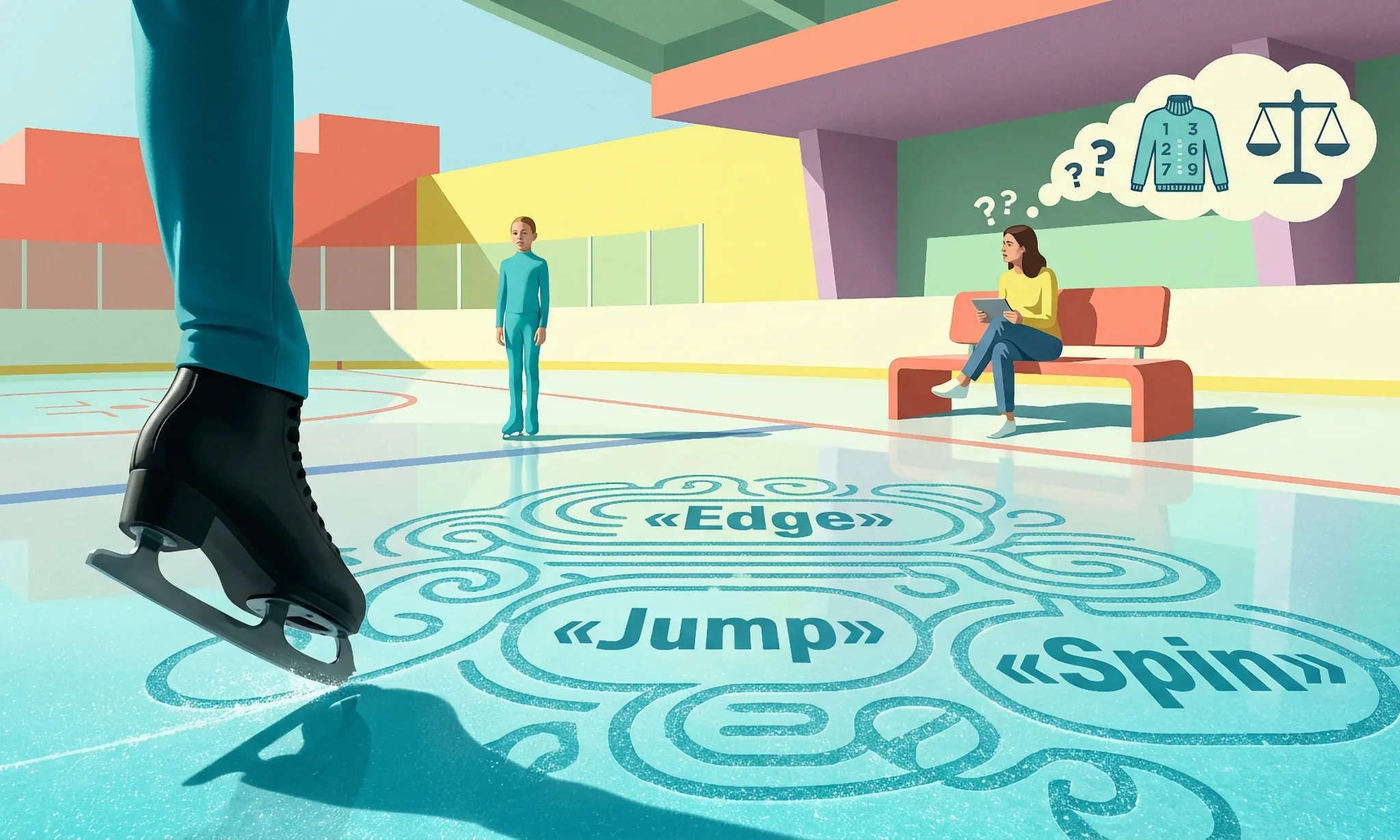
A mom pulled me aside at the boards last month, half-laughing, half-serious: "I need you to explain what my daughter just said. She told me she 'flutzed her lutz doing a three-turn into a camel' and I just smiled and nodded like I understood a single word."
I get a version of this conversation constantly. Figure skating has one of the densest specialized vocabularies in youth sports — dozens of jumps, turns, and spins that all look similar to an untrained eye but mean very different things to a coach or judge. Nobody hands new families a dictionary, and skaters pick up the language so gradually they forget their parents haven't.
So here it is: every term you're likely to hear at the rink, in one place, organized by category so you can jump straight to what you need. Bookmark this page — you'll be back.
Before jumps, before spins, before anything else — figure skating is built on edges. Nearly every term below eventually traces back to this one concept, so it's worth understanding first.
A skate blade isn't flat on the bottom. It has a hollow — a concave groove ground into it — which creates two distinct edges running the length of the blade: one on the inside (closer to the other foot) and one on the outside (away from the other foot). A skater is always riding on one of these two edges, leaning slightly into it, or briefly flat between them.
| Term | What it means |
|---|---|
| Inside edge | The edge of the blade closer to the body's centerline. Curves the skater's path toward the inside of the circle they're tracing. |
| Outside edge | The edge farther from the body's centerline. Curves the path outward. Generally considered the more "natural" edge for beginners to feel first. |
| Flat | Riding on neither edge — weight balanced evenly across the blade. Usually a technical error outside of specific transitional moments; reduces control and speed. |
| Deep edge | A pronounced lean into an edge, producing a sharp curve and strong power. A hallmark of advanced skating skill — judges specifically reward "edge quality" in scoring. |
| Shallow edge | A slight lean, producing a wide, gentle curve. Not wrong, just different — used deliberately in some moves, or a sign of underdeveloped edge control in others. |
| Edge quality | A specific, named criterion judges evaluate skaters on — how deep, clean, and controlled a skater's edges are throughout a program, independent of which jumps or spins they attempt. |
| Hollow | The concave groove ground into the bottom of a blade during sharpening, which creates the inside and outside edges. Rink pro shops adjust hollow depth (typically 3/8" to 5/8" radius) based on skater weight and level. |
| Rocker (blade rocker) | The lengthwise curve of a blade from toe to heel — not to be confused with the "rocker" turn below. Figure skate blades have significantly more rocker than hockey blades, enabling tight spins and turns. |
There are four possible edges in total once you combine direction and side: forward outside, forward inside, backward outside, and backward inside. Nearly every jump, spin, and turn in this glossary is defined by which of these four edges it takes off from or lands on — which is exactly why coaches talk about edges so constantly.
Turns and steps
Turns connect everything else in a program — they're how a skater changes direction or foot without stopping the flow of movement. Some are simple; a handful (marked below) are officially classified by the ISU as "difficult turns" that raise a program's technical level.
| Term | What it means |
|---|---|
| Three turn | A one-foot turn from forward to backward (or back to forward) that changes edge — outside to inside, or inside to outside — while continuing on the same curve. Traces a shape on the ice resembling the number 3. The most fundamental turn in skating; nearly everything else builds on it. |
| Mohawk | A two-foot turn from forward to backward (or vice versa) that changes feet but keeps the same edge type throughout. Think of it as a "step-through" turn rather than a pivot on one blade. |
| Choctaw | Like a mohawk, but changes both feet and edge type at once. More advanced and commonly used in ice dance for fluid, uninterrupted transitions. |
| Bracket* (difficult turn) | A one-foot turn that changes edge while rotating the body against the natural curve — counter-rotated. Traces a shape resembling a curly brace ( { ). Considered more advanced than a three turn. |
| Rocker* (difficult turn) | A one-foot turn that keeps the same edge type but changes the direction of the curve, rotating with the natural flow of movement. Not related to blade "rocker" above — same word, unrelated meaning. |
| Counter* (difficult turn) | A one-foot turn that keeps the same edge type while rotating against the curve's natural direction — the edge-preserving cousin of the bracket. |
| Twizzle* (difficult turn) | A fast, traveling one-foot turn with one or more full rotations, executed quickly while continuing to move across the ice — unlike a spin, which stays in place. A required, heavily-weighted element in ice dance, and one of the hardest things to do cleanly at speed. |
| Loop (as a turn/pattern) | A move that traces a small closed loop on one foot without changing edge or direction — also the origin of the name for the loop jump, which mimics this shape mid-air. |
| Spread eagle | Both feet turned outward, gliding on a straight or curved line with the body facing sideways to the direction of travel — often used as a dramatic entry into an Axel. |
| Crossover | The basic power-building move where one foot crosses over the other while skating a curve — the first "real" skating skill most beginners learn beyond gliding and stopping. |
*Marked turns are the ISU's six officially classified "difficult turns" — for singles/pairs it's bracket, counter, rocker, twizzle, choctaw, and loop; for ice dance, twizzle, rocker, counter, bracket, choctaw, and outside mohawk. Programs need a minimum variety of these, skated in both directions, to earn higher step-sequence levels. For the exact patterns and official diagrams tested at each USFS level, see our complete Moves in the Field Diagrams resource.
Jumps
Six jumps make up the core vocabulary of singles and pairs skating. They split into two families based purely on how the skater leaves the ice — this is the single fastest way to tell them apart when watching.
| Jump | Family | How it works |
|---|---|---|
| Toe loop | Toe jump | Takes off from a back outside edge, using the toe pick of the opposite foot to assist launch. The easiest and most common jump — usually learned first, and the default second jump in combinations. |
| Salchow | Edge jump | Takes off from a back inside edge, with a scooping swing of the free leg to generate rotation — no toe assist at all. |
| Loop | Edge jump | Takes off and lands on the same back outside edge, without a toe assist — requires strong edge control since there's no toe pick to help launch. |
| Flip | Toe jump | Takes off from a back inside edge with a toe-pick assist. Easy to confuse with a Lutz; the difference is entirely in the takeoff edge. |
| Lutz | Toe jump | Takes off from a back outside edge (opposite of the flip) with a toe-pick assist, approached on a long backward curve. Generally considered harder than a flip because the takeoff edge fights the jump's natural rotation. |
| Axel | Edge jump | The only jump that takes off forward, from a forward outside edge — which adds an extra half-rotation compared to every other jump at the same "number." A single Axel is 1.5 rotations, a double is 2.5, a triple is 3.5. Widely considered the benchmark jump of skating progress. |
Quick way to tell jump families apart while watching: toe jumps (toe loop, flip, Lutz) involve a visible tap of the toe pick into the ice right before takeoff — listen for it. Edge jumps (Salchow, loop, Axel) launch purely off the curve of the blade, no tap. The Axel is the only jump where the skater is facing forward at takeoff and backward at landing — once you can spot that, you'll never lose track of an Axel again.
| Term | What it means |
|---|---|
| Combination jump | Two or more jumps performed back-to-back with no steps or turns in between — the landing edge of one becomes the takeoff of the next. A triple Lutz–triple toe loop is a classic high-value combination. |
| Jump sequence | Similar to a combination, but with small steps or a turn connecting the jumps — worth somewhat less credit than a true combination. |
| Under-rotation | Landing a jump before completing the full number of rotations claimed — flagged by the technical panel and reduces the jump's credited value. |
| Flutz | Informal term for a Lutz accidentally taken off from the wrong (inside) edge, making it technically closer to a flip. Judges catch this and adjust scoring accordingly. |
| Lip | The mirror-image error — a flip accidentally taken off from an outside edge instead of the correct inside edge. |
| Waltz jump | A simple forward-takeoff half-rotation jump, usually the very first "real" jump beginners learn — a miniature preview of the Axel's forward takeoff. |
For the full breakdown of exactly how each jump is valued in scoring — including the real base-value tables from the current ISU rulebook — see our companion guide, How Figure Skating Scoring Works: GOE, PCS & IJS Explained.
Spins
Spins reward flexibility, centering, and speed — and unlike jumps, they're judged partly on how many full seconds a skater can sustain rotation in a controlled position.
| Term | What it means |
|---|---|
| Upright spin | Any spin performed standing tall on one foot — the base position most skaters learn first. |
| Scratch spin | A fast upright spin where the arms and free leg pull in tight to accelerate rotation speed — often the finishing flourish of a program. |
| Sit spin | The skater lowers into a seated position on the skating leg, with the free leg extended forward or to the side. |
| Camel spin | The free leg extends straight behind the body at hip height or above, creating a horizontal line — one of the most visually recognizable spin positions. |
| Layback spin | An upright spin variation where the skater arches the upper body and head backward while spinning — requires significant back flexibility. |
| Biellmann spin | The skater pulls the free leg up and overhead from behind, grabbing the blade — named after Swiss skater Denise Biellmann, who popularized it. One of the most demanding flexibility-based positions in the sport. |
| Donut spin | A camel spin variation where the skater grabs the blade of the free leg and pulls it toward the head, forming a rounded, "donut" shaped silhouette. |
| Flying spin | Any spin entered via a small jump rather than stepping directly into position — a flying camel or flying sit spin adds difficulty over the grounded version. |
| Combination spin | A single spin element that blends multiple positions (e.g., camel into sit into upright) in one continuous rotation without stopping. |
| Centered spin | A spin that stays in essentially one spot on the ice — the goal for most spins, as opposed to a "traveling" spin that drifts, which is a technical flaw. |
Spirals, lifts & other elements
| Term | What it means |
|---|---|
| Spiral | Gliding on one foot with the free leg extended behind at hip height or higher — a required element that rewards flexibility, extension, and pure edge quality rather than rotation or jumping. |
| Death spiral (pairs only) | One partner pivots low and nearly horizontal around the other, who anchors the position while skating a deep pivot circle. A signature pairs element with no equivalent in singles skating. |
| Lift (pairs/dance) | One partner lifts and carries the other while skating, often rotating. Ice dance lifts stay lower than pairs lifts by rule, but allow more creative shapes and holds. |
| Step sequence / footwork | A required, choreographed pattern of steps and turns performed across the ice in a straight line, circle, or serpentine shape — judged on variety, both-direction turns, and how well it matches the music. |
| Choreographic sequence | A freer required element (steps, spirals, arabesques, small jumps) judged as a whole artistic moment rather than element-by-element — a chance for personality and musicality to show through. |
| Hydroblading | A dramatic, deep-edge glide with the body tilted low, almost parallel to the ice — not an officially scored element on its own, but a popular artistic flourish. |
Programs and competition structure
| Term | What it means |
|---|---|
| Short program | The first, shorter of two competitive segments at most levels — a fixed, restrictive set of required elements performed in a tightly limited time. |
| Free skate / long program | The second, longer segment, giving skaters more freedom in element choice, though still built around required categories (jumps, spins, step sequences). |
| Moves in the Field (MITF) | The non-jumping test track that evaluates pure skating skill — edges, turns, control — independent of any program or music. The backbone of the USFS test system from Pre-Preliminary through Senior, with a parallel Adult track. |
| Element | Any individual scored component of a program — a jump, spin, lift, or step sequence, each with its own base value and quality assessment. |
| Discipline | The broad category of competitive skating: Men's/Women's Singles, Pairs, and Ice Dance are the four Olympic disciplines; Solo Ice Dance is a newer, rapidly growing fifth track recognized by the ISU. |
| Test session | A formal, non-competitive evaluation where a skater performs required elements in front of judges to earn an official USFS credential. For a complete walkthrough, see our guide to What Is a USFS Test Session? |
Scoring language
These come up constantly once a skater starts competing — and they're confusing enough that we wrote an entire dedicated guide to them. Here's the short version:
| Term | What it means |
|---|---|
| Base value | The fixed point value assigned to an element purely based on its difficulty, before any quality judgment is applied. |
| GOE (Grade of Execution) | A quality score from -5 to +5 applied to each element, adjusting its base value up or down based on how well it was performed. |
| PCS (Program Component Score) | The artistic and skating-quality score, covering Skating Skills, Composition, and Presentation — separate from individual element scores. |
| TES (Technical Element Score) | The sum of every element's base value plus GOE across the whole program. |
| IJS (International Judging System) | The current, points-based judging system used at all ISU and USFS qualifying events since 2004, replacing the old 6.0 system. |
| Deduction | Points subtracted from the total score for specific rule violations — falls, time violations, costume issues, and illegal elements each have a fixed penalty. |
We break every one of these down in full depth — including real base-value tables and worked scoring examples — in How Figure Skating Scoring Works: GOE, PCS & IJS Explained.
Equipment terms
| Term | What it means |
|---|---|
| Toe pick | The jagged teeth at the front of a figure skate blade, used to vault into toe jumps and assist certain turns — the single biggest visual difference from a hockey blade. |
| Boot stiffness | How much a skate boot resists ankle flex, scaled to skater level — too stiff restricts learning proper technique; too soft can't support jump landings. |
| Guards | Rubber or plastic blade covers worn when walking off the ice, protecting the sharpened edge from damage on hard floors. |
| Soakers | Soft fabric blade covers used for storage and transport, which absorb moisture and prevent rust — never store blades in hard guards. |
For a full walkthrough of choosing the right boots, stiffness, and fit for your skater's level, see How to Choose Your First Figure Skates: A Parent's Buying Guide.
Frequently asked questions
-
Toe jumps (toe loop, flip, Lutz) use the toe pick of the free foot to assist launch — you'll see a visible tap into the ice right before takeoff. Edge jumps (Salchow, loop, Axel) launch purely from the curve of the blade with no toe assist at all.
-
GOE stands for Grade of Execution — a quality score from -5 to +5 that judges apply to every jump, spin, and other element, adjusting its base difficulty value up or down based on how well it was performed.
-
A twizzle is a fast, traveling one-foot turn with one or more quick rotations, executed while still moving across the ice — unlike a spin, which stays in one spot. It's one of the ISU's officially classified "difficult turns" and a required, heavily weighted element in ice dance.
-
Both change feet while turning from forward to backward (or vice versa). A mohawk keeps the same edge type throughout; a choctaw changes the edge type as well, making it the more advanced of the two.
-
Because nearly everything else in skating — every jump, spin, and turn — is defined by which of the four edges (forward outside, forward inside, backward outside, backward inside) it starts or ends on. Edge quality is also a specific, named criterion judges score independently of any jump or spin content.
-
Moves in the Field (MITF) is the USFS test track that evaluates pure skating skill — edges, turns, power, and control — without any music or program structure. It's the foundation test ladder every competitive skater progresses through, from Pre-Preliminary to Senior, with a parallel Adult track.
A final thought
You don't need to memorize this page before your skater's next lesson. Nobody expects a parent to walk in fluent — coaches explain, skaters absorb it gradually, and the vocabulary builds on itself faster than it seems like it should. What actually helps is having somewhere to come back to when your skater casually mentions a "flutz" or asks if you saw their "closed choctaw," and you want the real answer instead of another confused smile at the boards.
Bookmark this page. You'll need it again before the season's over.
Kristen Fraser & Igor Lukanin is a 2-time Olympian and co-founder of Krigor Studio in Montclair, NJ, where new skating families get a plain-English introduction to the sport's language from day one.
Related reading: